Your Phone vs. The Border: A Traveler’s Privacy Tour of the G20
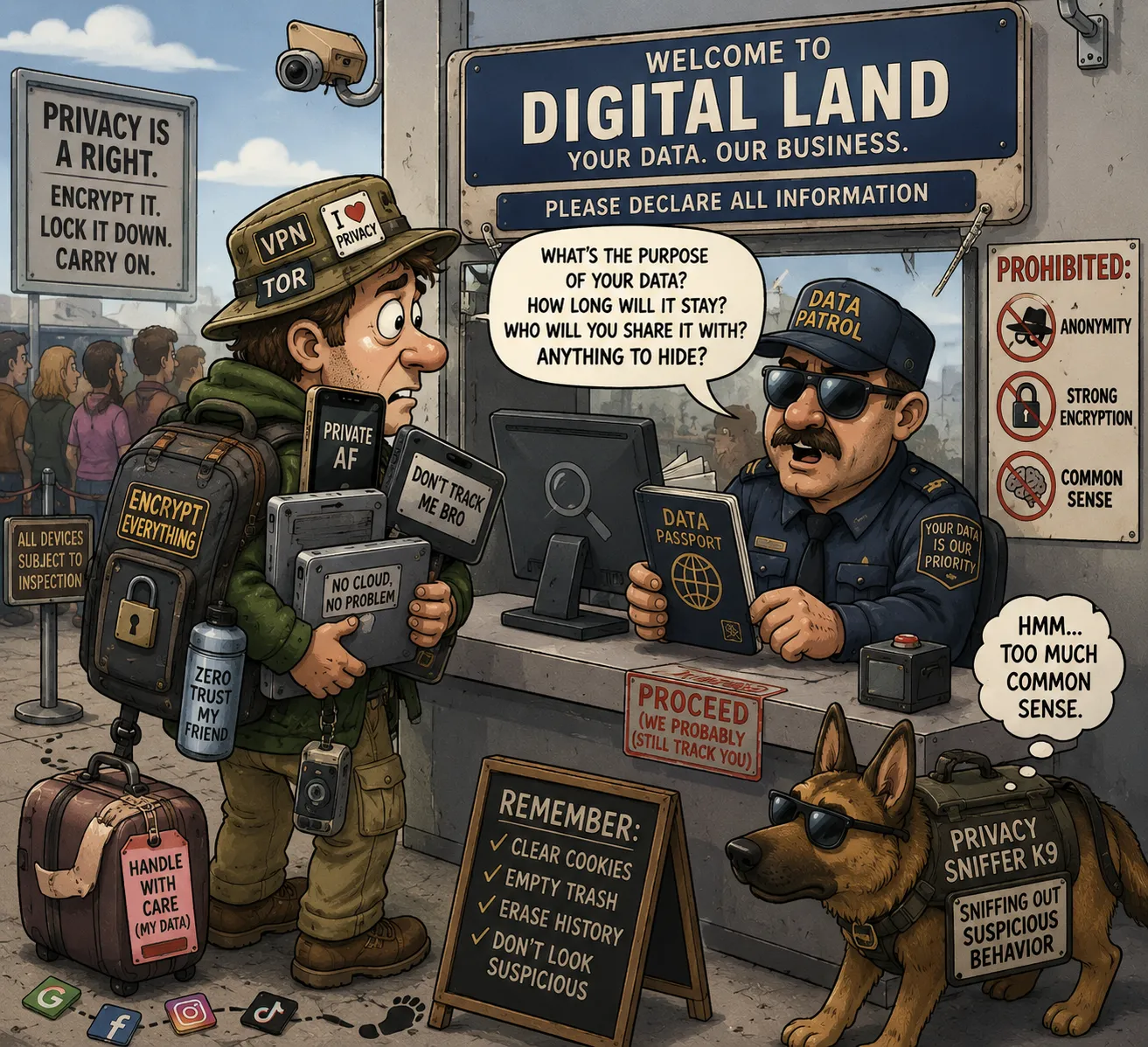
Travelers Rights. Or, lack thereof.
Disclaimers: Nothing in this article should be construed as legal advice. I am not a lawyer.
You probably spend more time with your smartphone than with most of your family. It contains your photos, banking apps, conversations, medical information, travel history, work documents, and enough embarrassing screenshots to keep you awake at night.
Then, you arrive at an international border.
Suddenly, that little rectangle in your pocket may become one of the most interesting objects you own — not to you, but to customs and immigration officers.
One of the biggest misconceptions among international travelers is that privacy rights remain exactly the same at a border crossing as they do everywhere else. In reality, nearly every country grants border officials broader search powers than ordinary police officers enjoy inside the country.
The details differ, but the overall pattern is consistent.
The Global Rule of Thumb
Among the G20 nations, Singapore, Panama, and the Philippines (as always, writing about places that I’ve lived, worked, and spent a lot of time), countries generally fall into three broad categories:
Privacy-Friendly
These countries typically recognize strong constitutional or statutory privacy rights and often require some level of legal justification before conducting especially intrusive electronic device searches.
Examples include:
- Germany
- France
- Italy
- Spain
- Japan
- South Korea
- Much of the European Union
Strong data protection laws (including the GDPR throughout the EU) don’t disappear at the border, but customs agencies still possess significant inspection authority. The main difference is that government actions are generally expected to satisfy principles of necessity, proportionality, and legal oversight.
Balanced Approach
These countries recognize privacy rights while also granting customs officers broad authority to inspect travelers and their belongings.
Examples include:
- Canada
- Australia
- United Kingdom (guest nation)
- Mexico
- Brazil
- South Africa
In many of these countries, courts have increasingly acknowledged that smartphones deserve greater privacy protection than ordinary luggage. That has led to ongoing legal reforms and court decisions that require at least some objective justification before officers examine digital devices in depth. Canada, for example, has been moving toward requiring a “reasonable general concern” before examining the contents of personal digital devices.
Security-First
Several countries place relatively greater emphasis on border security, customs enforcement, immigration control, or national security.
Examples include:
- United States
- China
- India
- Russia
- Saudi Arabia
- Türkiye
- Indonesia
- Argentina
Privacy protections still exist, but border agencies often possess broad legal authority to inspect luggage, question travelers, and in some cases examine electronic devices.
The United States is one of the most discussed examples because its border search doctrine permits searches of electronic devices without a traditional warrant. More advanced forensic examinations generally require additional justification under agency policy, although the legal landscape continues to evolve through court decisions.
Country-by-Country Snapshot
These ratings are intentionally broad and should not be interpreted as legal opinions. Local laws, court decisions, and agency policies can change.
United States
The United States recognizes a long-standing “border search exception” to the Fourth Amendment, giving U.S. Customs and Border Protection (CBP) broad authority to inspect travelers and their belongings — including electronic devices — without a warrant at ports of entry. In practice, searches of phones and laptops remain relatively rare (less than 0.01% of arriving international travelers in FY 2024), but every traveler should understand that they are legally possible. CBP distinguishes between basic searches, which involve manually reviewing a device and generally require no individualized suspicion, and advanced searches, which use external forensic tools and require reasonable suspicion or a national security concern under agency policy. U.S. citizens cannot be denied entry for refusing to unlock a device; although, the device may be detained and the inspection delayed. Foreign nationals face greater risk, as refusal to cooperate may be considered when determining admissibility. As with travel anywhere, carrying only the data you actually need, using strong encryption, disabling biometric authentication before arrival, and storing sensitive information, securely, elsewhere are prudent measures for protecting your digital privacy while recognizing the government’s significant border search authority.
Panama
Panama generally follows a practical customs enforcement model.
Border officers possess authority to inspect baggage and question travelers, but widespread routine forensic searches of electronic devices are not considered standard practice. As with most countries, travelers should expect customs inspections while also understanding that constitutional privacy protections remain part of Panamanian law.
Philippines
The Philippines presents a similar balance.
The Constitution protects against unreasonable searches and seizures, yet customs and immigration officers possess significant authority at ports of entry. Routine baggage inspections are common, and travelers should cooperate with lawful inspections.
Large-scale electronic device searches are not widely reported as routine practice, but travelers should not assume that digital devices are immune from inspection if officers believe further examination is justified.
Singapore
Singapore takes a security-first approach at its borders, and travelers should assume that customs and immigration officers have broad legal authority to inspect people, baggage, and belongings when enforcing customs and immigration laws. While Singapore has robust privacy laws governing how organizations handle personal data, those protections do not prevent lawful searches conducted by government agencies at border checkpoints. In practice, inspections of electronic devices are not routine for ordinary travelers, but if officers believe there is evidence of an immigration, customs, or other criminal offense, they have statutory authority to conduct searches as part of their enforcement duties. If you’re carrying particularly sensitive corporate or personal information, it’s wise to follow the same best practices you would for travel anywhere else: minimize the data you carry, encrypt your devices, and understand that border crossings occupy a unique legal space where privacy expectations are generally lower than they are once you’ve entered the country.
The Smartphone Has Changed Everything
Twenty years ago, customs officers searched your suitcase.
Today, your phone contains far more information than an entire suitcase ever could.
One unlocked smartphone might reveal:
- Years of messages
- Banking records
- Medical history
- Cloud storage
- Family photos
- Business documents
- Password managers
- Social media accounts
- Location history
Plus, a wide variety of other potential data points.
That’s why digital privacy has become one of the fastest-evolving areas of border law around the world.
Courts increasingly recognize that searching a smartphone is fundamentally different from opening a backpack. Legislatures are slowly updating laws to reflect that reality — but not all countries are moving at the same pace.
Practical Tips for International Travelers
No matter where you’re traveling:
- Keep devices encrypted.
- Install software updates before your trip.
- Back up important data before departure.
- Remove information you don’t actually need while traveling.
- Separate work and personal devices when possible.
- Understand the laws of both your departure and destination countries.
- If you carry privileged, confidential, or regulated information (such as legal, medical, or corporate data), understand your professional obligations before crossing a border.
- There is always the option of moving data that you need from your mobile device that you’d be carrying on your person to some type of cloud / NAS file system that could replicate the data to your final destination over the public internet. Of course, all recommendations around data encryption and maintaining privacy in that context still applies. For a large amount of data, this would quickly become a hassle; especially, if you travel often. On the other hand, if you are already running NAS appliances (with data replication) in multiple countries that you frequent, this may not be so much of a bother.
Summary
Borders have always been places where governments exercise powers they cannot ordinarily use inside the country.
What’s new is that your luggage no longer contains your most valuable information.
Your phone does.
As governments adapt decades-old customs laws to modern technology, travelers should expect border privacy rules to continue evolving. The safest assumption is simple:
Crossing an international border almost always means your expectation of privacy is lower than it is at home. Travel accordingly.
Notes
- AI / GenAI / ChatGPT / etc were used to gather some of the information in this article.
- ChatGPT was used to generate the images.
- I used em dashes in my writing before the current GenAI wave was a thing. Not planning on changing now.
- Names have been changed to protect the guilty.
- None of the hostnames or users used in examples actually exist.
- Feel free to post any comments or suggestions below.
- Nothing in this post should be construed as legal advice; I am not a lawyer.
Originally published on Medium.