Surveillance Capitalism: The Data Private Industry Gathers
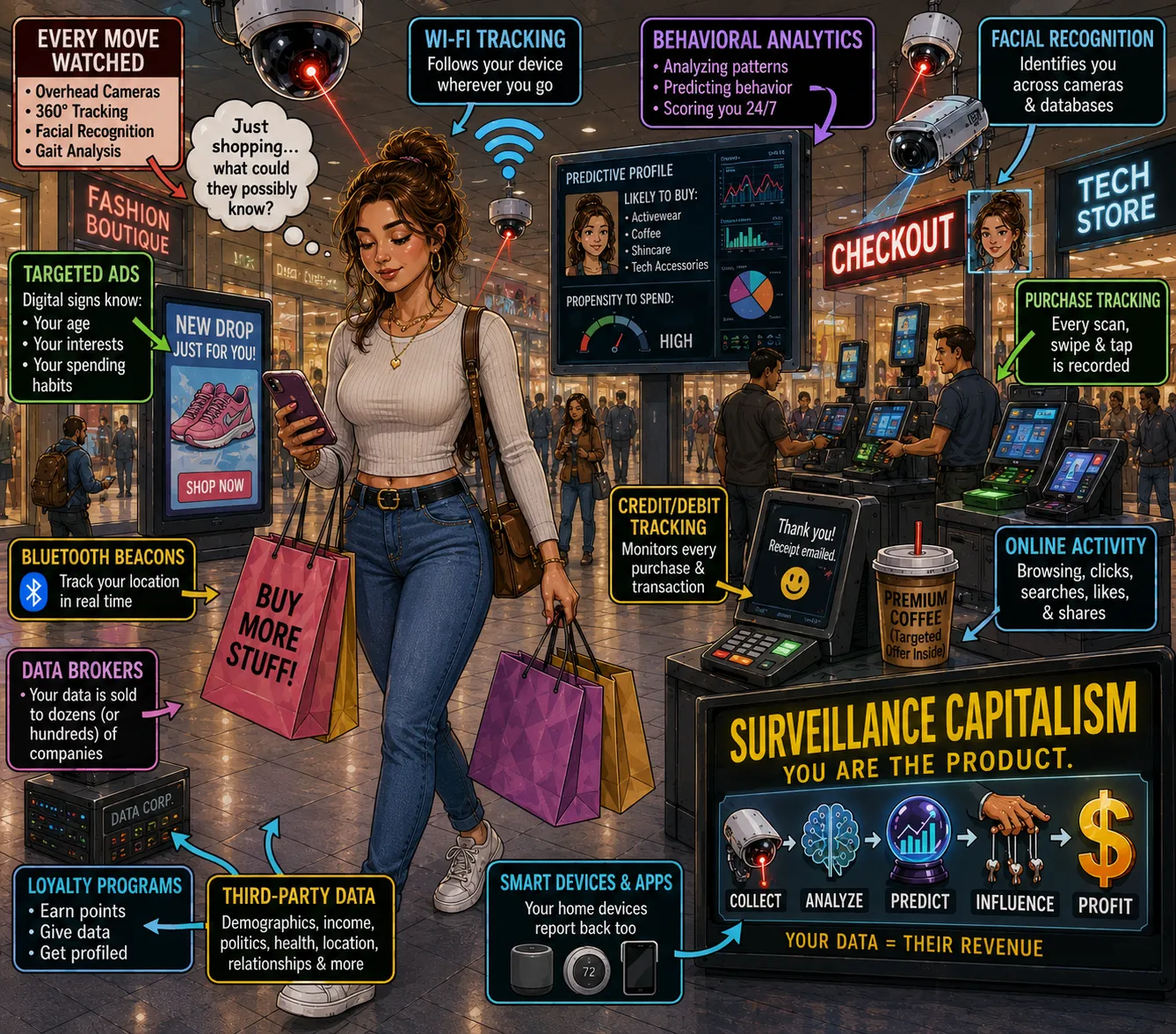
Surveillance Capitalism is an economic system in which companies collect, analyze, predict, and monetize human behavior through massive-scale data gathering and behavioral tracking — what Americans (the US kind) call Tuesday. The term was popularized by Shoshana Zuboff in her book “The Age of Surveillance Capitalism”. It is the commercialization of personal data and behavioral monitoring for profit, prediction, influence, and control. It’s a business model where your behavior becomes the raw material.
The key idea in Zuboff’s book is “behavioral surplus.” This concept is that companies collect more data than necessary to provide the service. That excess data becomes “behavioral surplus.” As an example, a map app technically needs your destination, route, and location, but it may also collect:
- Speed
- Stops
- Device identifiers
- Shopping visits
- Dwell time
- Movement habits
- Advertising interactions
That additional telemetry becomes economically valuable. And, certain companies are making a lot of money with it. Modern private industry attempts to gather anything that can be measured, inferred, predicted, monetized, or weaponized into targeted advertising. The list is enormous because data brokerage, analytics, AI training, surveillance capitalism, fraud detection, and behavioral prediction all feed on it.
Note, that various statements in this post may be sarcastic in nature. You should be able to tell which ones.
The major categories of the data gathered include the following.
Note, each section includes a sarcastic remark at the end. It’s okay, you can laugh.
Identity Data
Your Personal Identifying Information (PII) including:
- Full name
- Aliases/usernames
- Date of birth
- Gender
- National identifiers
- Driver’s license numbers
- Passport numbers
- Email addresses
- Phone numbers
- Physical addresses
- Mailing address
If only your most basic personal data really belonged to you.
Demographic Data
Your population / statistical characteristics including:
- Age range
- Marital status
- Household size
- Family relationships
- Education level
- Occupation
- Income estimates
- Language
- Home ownership/rental status
Americans say demographic data is private the same way malls say the security cameras are ‘for your safety’. Meanwhile twelve corporations already know you’re a divorced, left-handed coffee addict who impulse-buys air fryers after midnight.
Financial Data
Your money and purchasing behavior including:
- Credit card transactions
- Bank metadata
- Loan history
- Credit scores
- Mortgage information
- Investments
- Insurance policies
- Subscription payments
- Merchant history
- Spending categories
In the U.S., financial privacy works like a magic trick:
“Your data is completely private… right up until it’s shared with your bank, your credit card company, your payment processor, your payroll system, your tax software, and three companies you’ve never heard of that just ‘help with analytics.’”
Then everyone looks around and says, “Don’t worry, it’s still private — just widely distributed.”
Consumer Behavior Data
Your shopping and lifestyle patterns including:
- Purchase history
- Brand preferences
- Loyalty card activity
- Coupon usage
- Product browsing
- Shopping cart abandonment
- Return behavior
- Retail foot traffic
- Seasonal buying habits
In the U.S., consumer behavior data is so private that companies say:
“We absolutely respect your privacy… that’s why we carefully track every click, scroll, pause, hover, accidental swipe, and moment of existential hesitation when you looked at a toaster for 11 minutes.”
And don’t worry — none of it is personal. It’s just your digital personality profile, shopping mood index, and regret probability score. Totally anonymous. Probably.
Online Activity Data
Your internet behavior including:
- Browsing history
- Search queries
- Clickstreams
- Time spent on pages
- Referrer URLs
- Ad impressions
- Ad clicks
- Session duration
- Website interactions
- Cookies
- Browser fingerprinting
Online activity data is so “private” these days that it goes by a nickname: “It’s not tracking you — it’s just personally uninvited behavioral enrichment analytics.”
Mobile Device Data
Your smartphone telemetry including:
- GPS location
- Movement history
- Cell tower proximity
- Bluetooth proximity
- Wi-Fi networks
- App usage
- Screen interaction
- Device identifiers
- Advertising IDs
- Battery state
- Sensor data
Your mobile device data is so private that your phone promises: “I would never share your secrets.”
Then immediately texts them to your apps, your cloud account, your keyboard app, your weather widget, and that flashlight app you installed in 2017 that somehow still wants location access.
Meanwhile, maybe turn your phone off before you drive to the strip club.
Social Media Data
Your behavioral and relational data including:
- Posts
- Likes/reactions
- Shares
- Comments
- Followers/friends
- Photos/videos
- Facial imagery
- Social graphs
- Messaging metadata
- Hashtags/interests
- Engagement timing
At this point, only an idiot is sharing anything personal on social media. Just stop.
Communication Data
Your metadata and sometimes content including:
- Email metadata
- Call logs
- SMS metadata
- Chat activity
- Voicemail metadata
- Contact lists
- Meeting participation
- Collaboration platform activity
Your mobile telecom provider helpfully stores your text messages on their servers for years. Plan accordingly.
Location and Movement Data
Your physical movement and tracking data including:
- GPS traces
- Check-ins
- Commute patterns
- Home/work inference
- Travel history
- Airport activity
- Hotel stays
- Toll usage
- Rideshare history
- Parking behavior
Location data companies always say, “We value your privacy.”
Which is comforting, because apparently they know exactly where you were when you read that.
Vehicle and Transportation Data
Your connected mobility telemetry including:
- Vehicle VINs
- Driving habits
- Speed
- Braking patterns
- Routes
- Charging history (EVs)
- Telematics
- Fleet management data
Modern cars increasingly resemble surveillance devices that occasionally permit transportation.
Health and Wellness Data
Your medical and biometric indicators including:
- Prescription records
- Insurance claims
- Fitness tracker data
- Sleep metrics
- Heart rate
- Reproductive health tracking
- Diet logging
- Mental wellness app usage
- Genetic testing data
Healthcare data is supposedly protected by the strictest privacy laws on Earth.
Meanwhile you sneeze near your phone once and suddenly every ad is like: “YOU MAY BE INTERESTED IN ADVANCED RESPIRATORY WELLNESS SOLUTIONS FOR MEN OVER 40.”
Biometric Data
Your human physical characteristics including:
- Facial recognition vectors
- Fingerprints
- Voiceprints
- Iris scans
- Gait analysis
- Typing cadence
- Behavioral biometrics
Biometric data is incredibly private.
That’s why companies only collect your face, fingerprints, voice, iris pattern, walking gait, typing rhythm, and heartbeat signature.
You know — the anonymous stuff.
Employment Data
Work-related monitoring:
- Payroll
- Attendance
- Productivity metrics
- Badge access logs
- HR evaluations
- Training records
- Device usage
- Workplace communications
Employment data is totally private.
That’s why before you even finish applying, 14 systems already know your salary history, your manager’s opinion of you, your coffee habits, and that one time in 2019 you marked yourself “open to work” for six minutes.
Educational Data
Student and learning analytics:
- Grades
- Testing performance
- Attendance
- Learning platform usage
- Behavioral analytics
- Certifications
- Research activity
Educational data is completely protected.
Which is great, because now only your school, testing agencies, learning apps, scholarship portals, recruiters, and three “student success analytics partners” know you failed algebra twice in 10th grade.
Smart Home / IoT Data
Connected device telemetry:
- Smart thermostats
- Doorbell cameras
- Security systems
- Voice assistants
- Appliance usage
- Lighting automation
- Occupancy inference
Humanity invented refrigerators capable of reporting usage analytics to multinational corporations because apparently cold vegetables alone were not ambitious enough.
Entertainment Data
Media consumption:
- Streaming history
- Watch duration
- Music preferences
- Gaming activity
- Achievement patterns
- Viewing habits
- Reading patterns
Entertainment data is totally private.
That’s why your streaming service can instantly recommend “Dark Scandinavian Crime Dramas Featuring Emotionally Exhausted Detectives” after you watched exactly one breakup movie and a documentary about bread at 2 a.m.
Advertising and Marketing Data
Inferred commercial profiles:
- Predicted interests
- Purchase intent
- Political leanings
- Lifestyle segmentation
- Propensity scoring
- Marketing personas
- Risk scores
Marketing data is completely private.
Advertisers don’t know who you are — they just know you’re a 34-to-49-year-old night-scrolling stress shopper who almost bought cargo pants at 1:13 a.m. and can be emotionally influenced by free shipping.
On a major commercial website, it’s not unusual for:
- 20–100+ third-party domains to load
- 10–50+ companies to participate in ad-tech processes
- Hundreds of tracking requests to occur during a browsing session
Some academic studies and browser analyses have found that popular websites can expose user data to dozens or even over a hundred distinct entities through cookies, scripts, SDKs, and bid requests.
The real absurdity is that the ad auction happens in milliseconds:
- You open a page.
- Your browser announces details about you/device/interests.
- Multiple companies bid to show you an ad.
- An ad appears before you can even finish wondering why you’re suddenly seeing ads for ergonomic camping socks.
A few major players dominate large portions of the ecosystem, including Google, Meta, Amazon, The Trade Desk, and Criteo, but beneath them is a sprawling ecosystem of thousands of specialized firms.
Relationship and Social Graph Data
Connections between people:
- Family structures
- Friends
- Colleagues
- Interaction frequency
- Group affiliations
- Romantic associations
Social graph data is completely private.
Your apps don’t know who your friends are — they just know who you talk to, where you meet, how often, how long you pause before replying, and which one of you is clearly the “send memes instead of feelings” friend in the group.
Public Records Aggregation
Collected and enriched public info:
- Property ownership
- Court filings
- Business registrations
- Marriage/divorce
- Voting records
- Professional licenses
There are literally 1000s of websites selling this information about Americans (US persons) online.
Cybersecurity / Technical Telemetry
Technical infrastructure data:
- IP addresses
- Device fingerprints
- Login behavior
- Network activity
- Threat intelligence
- Authentication patterns
- Session tokens
Cybersecurity telemetry is totally private.
Your security software only collects harmless little details like every process you run, every file you open, every website you visit, your device fingerprints, network traffic patterns, login behavior, and the exact millisecond you clicked something suspicious.
You know — just enough data to protect your privacy.
Behavioral Prediction Data
AI-generated inferred attributes:
- Likelihood to purchase
- Fraud probability
- Creditworthiness
- Political persuasion susceptibility
- Churn likelihood
- Risk scoring
- Psychological inference
This is where things become especially dystopian: companies increasingly value not just what you did, but what statistical models think you will probably do next.
Environmental and Contextual Data
Surrounding-world telemetry:
- Weather correlation
- Local events
- Traffic patterns
- Nearby devices
- Crowd density
- Retail occupancy
Data Derived Through Inference
This is one of the most important categories.
Even if you never explicitly provide:
- Religion,
- Political views,
- Sexuality,
- Health conditions,
- Financial stress,
models may infer them from:
- Purchases,
- Movement,
- Browsing,
- Social connections,
- Language patterns.
This is why “I never told them that” often no longer matters.
Summary
The key thing to understand is most companies no longer think in terms of what product do we sell?
They think what telemetry can we capture?
Because behavioral data improves:
- Advertising
- AI
- Pricing
- Targeting
- Prediction
- Monetization
Your behavior itself has become the raw material of highly profitable business models.
Civilization accidentally built a planetary-scale behavioral sensing network, then realized it could also use it to sell breakfast cereal, predict elections, detect fraud, optimize logistics, train AI models, and determine which human is statistically most likely to click on an ad for tactical socks at 3:12 AM on any random Tuesday.
Notes
- AI / GenAI / ChatGPT / etc were not used to generate the text of this article.
- ChatGPT was used to generate the images.
- I used em dashes in my writing before the current GenAI wave was a thing. Not planning on changing now.
- Names have been changed to protect the guilty.
- None of the hostnames or users used in examples actually exist.
- Feel free to post any comments or suggestions below.
Originally published on Medium.