Sweden’s Cashless Revolution: The Hidden Costs of a Digital Economy
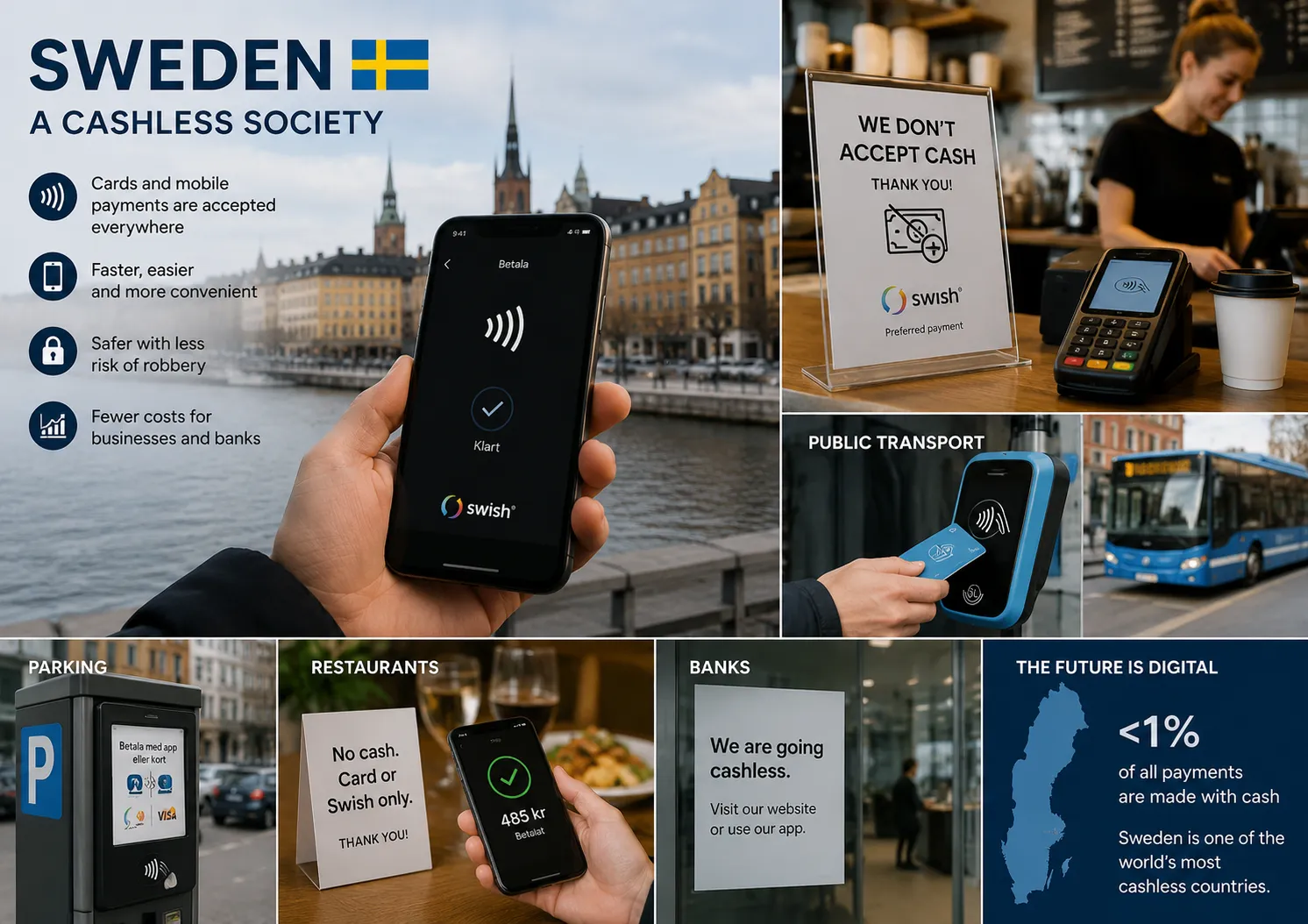
In my “Dangers of a Cashless Society” post, I briefly described my experiences in Sweden. This post expands on that.
For years, Sweden has been celebrated as the world’s leading example of a cashless society. In many Swedish cities, it is entirely possible to live for weeks without touching a banknote or coin. Public transportation, restaurants, retail stores, and even some banks have largely abandoned cash in favor of cards and mobile payment applications. Yet, it should be noted that ATMs can be found, often at transportation hubs, if one should need it.
The transition has brought undeniable benefits. Digital payments are convenient, efficient, and difficult to rob. Businesses spend less time handling cash, and consumers can complete transactions with a simple tap of a card or smartphone.
Yet Sweden’s rapid move toward a cashless economy has also revealed significant challenges. As the country has become a global model for digital payments, it has simultaneously become a case study in the risks of relying too heavily on electronic financial systems.
Financial Exclusion
One of the most frequently cited concerns is the impact on vulnerable populations. Elderly citizens, people with disabilities, immigrants, and those who struggle with technology can find themselves excluded from everyday economic activities. My mother has adopted to the modern smartphone well enough; my father tends to hand his to my mother or one of his adult children to get basic functions operational for himself. My grandmother never used a computer and never owned a smartphone (she did have a simple flip phone with a couple of numbers programmed into it)— she died in 2015. They might as well have been asking to pilot the space shuttle — she wasn’t Swedish, but she was elderly.
While younger generations adapt easily to mobile payment applications, many older Swedes grew up using physical currency and may not feel comfortable managing finances entirely through digital platforms. When stores stop accepting cash, these individuals can face barriers to making basic purchases and participating fully in society.
Increased Dependence on Technology
A cashless society is only as reliable as the technology that supports it. Payment networks, mobile applications, telecommunications infrastructure, and electrical grids all become critical components of daily life.
When technical failures occur, consumers and businesses may find themselves unable to conduct transactions. A network outage that might once have been an inconvenience can become a significant economic disruption when cash is no longer available as a backup payment method.
This dependence raises important questions about resilience. In a society where nearly every transaction is digital, even temporary disruptions can have widespread consequences.
Technology is great. I love the conveniences, but I also want the sun to rise tomorrow if the technology / service goes sideways. If the payments network is done, you as an individual should have the ability to (through cash) and the system should allow (plan) for buy(ing) groceries.
Cybersecurity Risks
As more financial activity moves online, cyberattacks become a greater threat. Criminal organizations increasingly target banks, payment processors, and digital payment platforms. Fraud, account takeovers, phishing attacks, and ransomware incidents can affect millions of users.
A cashless economy concentrates risk within digital systems. While physical cash can be stolen, a successful cyberattack against a major payment provider can disrupt transactions across an entire nation.
The more society depends on electronic payments, the more important cybersecurity becomes to national stability.
Privacy Concerns
Cash provides a level of anonymity that digital payments cannot easily replicate. Every electronic transaction creates data that may be stored, analyzed, and shared by financial institutions, payment providers, and governments.
Supporters of digital payments argue that transaction records help prevent fraud and financial crime. Critics counter that a fully cashless society creates unprecedented opportunities for surveillance.
When every purchase leaves a digital trail, citizens may lose a degree of financial privacy that previous generations took for granted.
National Security Implications
In recent years, Swedish authorities have expressed growing concern about the country’s declining use of cash. As geopolitical tensions increase across Europe, policymakers have begun to reconsider the wisdom of eliminating physical currency entirely.
In the event of war, cyber warfare, large-scale infrastructure attacks, or prolonged power outages, cash can serve as a resilient backup system. Physical currency does not require electricity, internet access, or functioning telecommunications networks.
Some experts now argue that maintaining cash circulation is not merely an economic issue but a matter of national preparedness.
Reduced Consumer Control
Cash offers consumers immediate control over their spending. Numerous studies have suggested that people often spend more when using cards or mobile payments because digital transactions feel less tangible than handing over physical money.
A fully digital economy may therefore contribute to higher consumer debt levels and reduced awareness of personal spending habits.
For some households, cash serves as an important budgeting tool that is difficult to replicate electronically.
The Need for Balance
Sweden’s experience demonstrates that the debate is not simply about choosing between cash and digital payments. The challenge is finding the right balance between innovation, convenience, security, and resilience.
Digital payments offer substantial advantages and are likely to continue growing. However, Sweden’s journey suggests that eliminating cash entirely may create new vulnerabilities that policymakers did not initially anticipate.
The lesson for other countries may be that while a cashless future is technologically possible, preserving access to physical currency remains an important safeguard against exclusion, system failures, cybersecurity threats, and national emergencies.
As societies continue to modernize their financial systems, Sweden’s experience serves as a reminder that progress often comes with trade-offs — and that resilience sometimes requires maintaining older systems alongside newer ones.
Notes
- AI / GenAI / ChatGPT / etc were not used to generate the text of this article.
- ChatGPT was used to generate the images.
- I used em dashes in my writing before the current GenAI wave was a thing. Not planning on changing now.
- Names have been changed to protect the guilty.
- None of the hostnames or users used in examples actually exist.
- Feel free to post any comments or suggestions below.
Originally published on Medium.