Dangers of a Cashless Society
Table of Contents
Introduction
What Does Cashless Mean?
Countries Embracing Going Cashless
Why Cashless Advocates Dislike Cash
- Cash Is Hard to Track
- Cash Enables the Shadow Economy
- It’s Inefficient and Costly
- Theft and Loss Risk
- Friction in Commerce
- Limits Financial Innovation
- Public Health Argument (Post-COVID)
Common Talking Points from Cashless Proponents
- “Cash fuels crime.”
- “Digital payments are safer.”
- “It improves tax collection.”
- “It’s more convenient.”
- “It promotes financial inclusion.”
- “It modernizes the economy.”
- Loss of financial privacy
- Increased financial surveillance
- Systemic technology failure
- Cybersecurity risks
- Financial exclusion
- Market power of payment intermediaries
- Reduced economic resilience
- Behavioral and spending effects
- Political and social control risks
- Loss of monetary backup
Introduction
This is the next post in my Privacy Series. My interest in this topic comes from its privacy implications and my personal interest in disaster preparedness, which includes having a plan for paying for basic essentials if the lights are out.
Due to the size and number of sections of this post, I’m changing my usual format to have a table of contents. We will see how this works for people. If it doesn’t, I’ll break this up into multiple posts.
There are many concerning developments in the privacy space. I wish I had time cover all of them, but this topic, a Cashless Society, I have found interesting for years. The younger, urban crowd and the technology community are large proponents of this future.
A cashless society is one where most or all financial transactions occur through digital systems — credit cards, bank transfers, mobile wallets, or other electronic payment methods — rather than physical currency. While this can increase efficiency and convenience, it introduces several potential systemic risks and societal challenges.
Many of the Northern European countries present themselves as Cashless Societies. The one country I visit quite often is rather proud of it. During one particular trip, I was having serious problems with my credit cards working. Not sure what was happening that week, but my bank and that particular EU country were just not getting along that week. On previous trips, there were no issues and on subsequent trips things have worked just fine — that’s not entirely true, I’ve never been able to get my Bank of America debit card to work at the train station in that city. But, that week, I found an ATM machine at the closest train station, pulled out a few hundred Euros and paid for lunch each day in cash. Not important to our current discussion, but I have always found it fascinating when you pay in one currency and receive change in another, which is common in some EU countries.
Even as one of the locals was bragging about living in a Cashless Society, I was still able to 1) Find an ATM machine, 2) Get cash, 3) Find several eateries that would take cash that served food I liked, and 4) make sure I did it all in sight of Mr. “Cashless Society” Boy (I can be very annoying, as was he).
I like the convenience of all the non-cash payment solutions as much as the next person. Overall, security has improved dramatically in that space, but privacy concerns have increased exponentially. I absolutely do not want to live in a world where cash has disappeared as an option for everyday payments due to those privacy implications or what happens when the power goes out (emergencies, terror attack, etc). There’s also a significant portion of the world’s population that is “unbanked” or doesn’t have access to one (or more) other prerequisites required to participate in a Cashless Society.
What Does Cashless Mean?
There is the obvious definition of nobody accepting cash, using cash, or even having access to physical cash, but the situation is usually more nuanced than that. Most countries claiming to have gone “cashless” still have cash, but there is far less of it in use. So, a Cashless Society
- Prefers non-cash payment solutions.
- Those non-cash payment solutions could be credit cards, debit cards, cards tied into smart-phone based digital wallet apps such as ApplePay / GooglePay / SamsungWallet(SamsungPay), cryptocurrencies, a locally-mandated central-bank issued digital currency, a digital wallet + payment app that is widely adopted by people + vendors / businesses in a country (WeChatPay in China, GCash in the Philippines, etc). There are others.
- Generally, cash is still issued by the government mint. There is noticeably less physical money in circulation.
- Citizens can, usually, still deposit “cash” into an account at a bank branch. There are exceptions.
- Often, businesses / vendors / organizations can decide whether they want to accept cash or not.
- Sometimes, governments mandate that cash must still be accepted everywhere or at least for certain types of businesses and government offices.
It’s really important to understand the situation on the ground before going to a country that presents itself as a “Cashless Society.”
Countries Embracing Going Cashless
The most cashless countries are concentrated in Northern Europe and East Asia, with places like Sweden, Norway, China, and South Korea leading the shift toward digital-only economies.
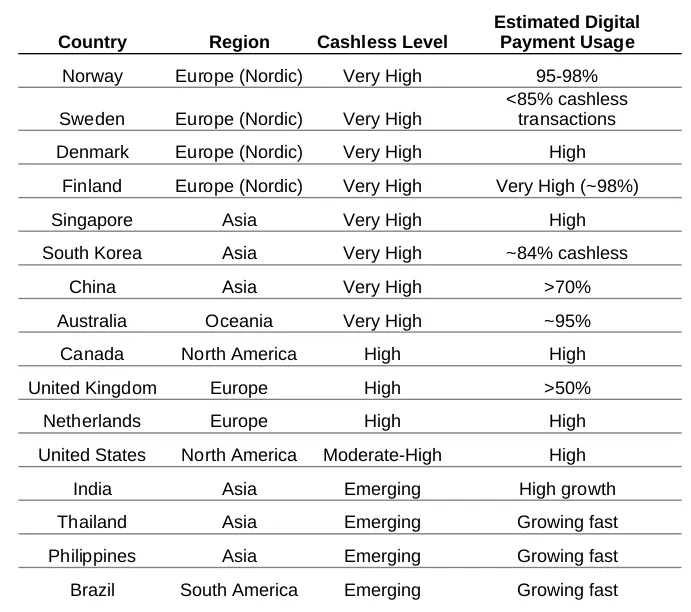
Highest Embrace of Cashless Society
Chat GPT was used to to gather this data. I did several spot checks against other sources and it generally seemed to be accurate.
As noted before, medium.com doesn’t have direct support for tables; so, I formatted this table in LibreOffice Calc, exported as a PDF, and grabbed a screenshot of it. Works well enough.
All of these countries have several commonalities that ease adoption of a cashless society.
Strong Infrastructure:
- Reliable internet
- High banking penetration
Government Push:
- Digital ID systems
- National payment rails
Cultural Adoption:
- Trust in digital systems
- Convenience over cash
Even these most “cashless” countries:
- Still legally require cash acceptance in many cases.
- Maintain cash for resilience (e.g., outages, emergencies).
- Are reconsidering how far to go due to security concerns.
In the emerging category, those countries are expanding reliable internet access and access to banking rapidly, but there can still be regions with significant gaps in both.
The Covid19 pandemic was used as an opportunity by several of these countries to push for and greatly expand their implementation of a Cashless Society.
Why Cashless Advocates Dislike Cash
Cashless advocates aren’t secretly plotting in a smoky room. They’re mostly optimizing for efficiency, visibility, and control (maybe, propping up a share price somewhere or honestly believe they are making the world a better place), but those goals come with tradeoffs that critics (often correctly) worry about. The reasons cashless advocates dislike cash include:
- Cash Is hard to track
- Cash enables the shadow economy
- It’s inefficient and costly
- Theft and loss risk
- Friction in commerce
- Limits financial innovation
- The public health argument (Post-COVID)
Many of these points are interrelated or different side of the same coin (pun intended).
For the pundits in wealthy, developed economies that can’t wait to implement these ideas, they should probably spend a bit of time in some of those nations with less-developed economies in the “emerging” category above or experience a couple of natural disasters that knock out vital infrastructure for days or weeks.
I’ve sprinkled in commentary, often sarcastic in nature, throughout these points.
Cash Is Hard to Track
Cash transactions leave no automatic audit trail (hence, its allure for privacy advocates and issue for policy makers).
From a policy and business perspective, that’s a problem:
- Harder to detect tax evasion (this is an issue, but tracking cash transactions has always been an issue).
- Easier to hide income (also, a very real and legitimate issue)
- Difficult to analyze economic activity (because there are no known issues with measuring inflation, unemployment, and GDP in the US or other countries, more sarcasm).
Digital payments create data; that data is power (read, control and money) for governments and companies.
Cash Enables the Shadow Economy
This is the other side of the first item in this list.
A big argument in favor of a Cashless Society is that cash supports:
- Under-the-table labor (it’s beer money guys, come on)
- Tax avoidance
- Black market activity (more beer money)
Proponents argue that reducing the use of cash shrinks the informal economy and increases tax compliance.
These are typically goals of policy makes in developed economies such as those found in Northern Europe and North America, but for numerous countries in less developed parts of the world, the informal economy is a huge part of their economy regardless of how it is measured (GDP or Workforce). For such countries, it is not typically cost effective (or even realistic) to attempt to measure / tax the informal economy. So, these countries try to offer incentives to individuals and business to join the formal economy. Though, efforts and results do vary wildly. This is an interesting topic, but wildly beyond this post. For comparison, we have the following break down across various countries:
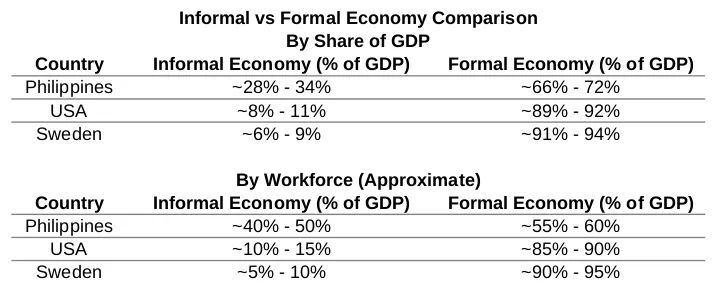
Formal vs Informal Economy Estimates Across Countries
For comparison, Sweden has significant cashless payment options adoption at 90–95%. The US, less so, but still significant at 85%–87%. The Philippines digital/non-cash retail transaction value is 59% as of 2024. All those numbers would imply that there is a correlation between cashless payments adoption and the size of the informal economy. That intuitively makes sense.
ChatGPT generated the numbers quoted in this section.
It’s Inefficient and Costly
Handling physical cash isn’t free:
- Printing and minting money.
- Transport and security (government, bank, business, and individual level).
- Maintaining brick and morter retail bank locations.
- Cash handling at businesses (counting the cash is part of the closing routine, got to get the money into the bank before it is stolen, theft for large amounts of money is a very real concern).
- ATM infrastructure.
Digital systems are seen as:
- Faster
- Cheaper at scale
- Easier to automate
Sarcasm: to compensate for the “cheaper at scale” part, this tends to fall out as a rent extraction through a small fee on every transaction in the digital currency by whoever / whatever controls the digital payment platform(s) and / or every hop between payer and payee.
Theft and Loss Risk
Cash is generally:
- Easier to steal
- Impossible to recover, if lost.
Digital payments can:
- Be reversed (sometimes)
- Be monitored for fraud (mostly)
- Include protections (many caveats)
It would be foolish to present non-cash payment options as having no risk of loss or theft. Just look at some of the cryptocurrency related losses of the last few years or stats on credit card fraud from banks.
Likewise, consider how using a credit card may be safer for a consumer, generally, than using cash, but then the business owner has to contend with fraudulent reversals and associated costs. You’ve shifted the risk, but not eliminated it.
Friction in Commerce
Cash slows things down:
- Making change (can anyone under the age of 50 do this without a calculator?)
- Counting money
- Reconciling registers
Cashless systems:
- Speed up transactions (sometimes, modern credit card scanner systems are slower than the ones used twenty years ago in the US; how many times do you have to tap your phone to get the NFC scanner to detect it?)
- Enable online and remote payments
- Integrate with apps and services
Limits Financial Innovation
Cash doesn’t integrate with:
- Online subscription services
- Digital platforms
- Automated billing
- Embedded finance
A cashless system enables entirely new business models.
I’m reminded of the Paul Volcker, 2009, quote, “The ATM has been the only useful innovation in banking for the past 20 years.”
Can I get a “Hallelujah”? Yes, this is more sarcasm.
On most days, slowing down the FinTech community feels like a good thing.
Public Health Argument (Post-COVID)
This one gained traction during and after the Covid-19 pandemic mitigation efforts.
This comes down to:
- Cash is physically handled; thus,
- Seen (rightly or wrongly) as a vector for germs
Several countries used this as a pretext to push forward (or accelerate adoption) of various payment solutions to limit the use of cash within their borders.
While it may not be practical to mandate everyone wear medical-grade rubber gloves while handling cash, banning cash in the name of public safety falls firmly in the “never let an emergency go to waste” category.
Common Talking Points from Cashless Talking Heads
You’ll hear these repeatedly:
- “Cash fuels crime.”
- “Digital payments are safer.”
- “It improves tax collection.”
- “It’s more convenient.”
- “It promotes financial inclusion.”
- “It modernizes the economy.”
Let’s briefly explore each.
“Cash fuels crime”
Argument:
- Criminals prefer untraceable transactions.
- Removing cash reduces illegal activity.
Counterargument:
- Crime doesn’t disappear; it, often, shifts to digital methods.
Also, one must stop and ask how human civilization was not utterly consumed by crime for the XX thousands of years of history with only cash following this line of reason? Maybe, it was. Or, what happened in barter-based societies?
“Digital payments are safer”
Argument:
Digital payments platforms feature:
- Fraud detection systems.
- Transaction monitoring.
- Account protections.
Counterargument:
Also introduces:
- Identity theft.
- Account takeovers.
- System-wide vulnerabilities.
- Algorithmic platform bans with little recourse for the end user.
- An immature / non-existent regulatory environment.
“It improves tax collection”
Argument:
- More transparency means higher compliance; so,
- Governments collect more revenue.
Counterargument:
- Also increases financial surveillance; hence, decreases privacy for everyone.
Tax collection is a hot button topic that goes far beyond the scope of this blog post. It is an important issue. The comments made in this post are not meant to suggest otherwise.
“It’s more convenient”
Argument:
- Tap, scan, done.
- No need to carry cash.
Counterargument:
- Convenience often trades off with privacy and control.
“It promotes financial inclusion”
Argument:
- Mobile payments help unbanked populations
- Easier access to financial systems
Counterargument:
This assumes all members of society have access to:
- Smartphones
- Internet
- Digital literacy
The exact same points are made by groups against migrating to an exclusively Cashless Society. Those are some big assumptions listed above.
The elderly, poor, and some immigrant / minority groups may be missing one-or-more of these assumptions. This situation will vary dramatically from one country to the next.
“It modernizes the economy”
Argument:
- Aligns with global digital trends
- Enables innovation and growth
Counterargument:
This can leave behind:
- Rural populations
- Elderly users
- Low-income groups
Imagine trying to get your older parents or grandparents on-boarded into these systems. Or, what happens when something goes wrong.
That innovation and growth can (and very often does) benefit a small segment of the population.
Do We Really Want To Do This?
The major dangers often discussed by economists, technologists, and policy analysts include:
- Loss of financial privacy
- Increased financial surveillance
- Systemic technology failure
- Cybersecurity risks
- Financial exclusion
- Market power of payment intermediaries
- Reduced economic resilience
- Behavioral and spending effects
- Political and social control risks
- Loss of monetary backup
Loss of Financial Privacy
Cash transactions are anonymous, while digital payments create detailed records. The associated risks include:
- Governments gaining the ability to monitor individual spending habits
- Corporations building extensive consumer behavior profiles
- Data breaches exposing financial activity
- Use of transaction data for law enforcement or political purposes (just because there’s someone in charge at the moment you consider friendly, that can change in the next election cycle or the next national emergency). Eventually, every data point an government has access to about its population will be used for purposes other than what it was originally intended.
In a fully cashless system, every purchase leaves a permanent digital trace. Maybe, you still want to use cash when you go to certain clubs— who wants an official record of that to be around forever? Or, maybe your donation to your favorite political, religious, social cause is better done in cash to avoid a permanent record of your association with that organization (ask people who supported the Canadian Freedom Convoy protest about that).
In the United States, there are no universal data privacy laws that limit how that data is used or who it is shared with. Other places, like the EU have the GDPR (or similar laws) that provides much stronger protections for one’s personal data and digital privacy.
Increased Financial Surveillance
This one ties directly into the last one, but goes beyond the simple loss of privacy.
Digital systems allow institutions to:
- Freeze accounts
- Block transactions
- Monitor purchases in real time
If financial access is controlled through centralized systems, authorities or companies could potentially restrict (and have done so many times) access to money for regulatory, legal, or political reasons.
Some analysts refer to this as “programmable money risk.”
- Of course, terrorism and hurting / killing people for whatever reason is not good — steps should be taken to eliminate those activities whenever possible. Unfortunately, there is a lot of gray area in that pursuit.
- What happens when the terrorist designations change whenever the occupant of the White House (USA, or whatever the address of your political leaders)? Probably, an edge case, but we are inching closer to this with each new administration.
- What happens when the politicians and government bureaucrats finally decide / realize that all the mechanisms (timing, justification, etc) are in place to start dictating who can spend, how much (min / max), on what, when?
Systemic Technology Failure
Cash functions without electricity or networks. Credit cards, debit cards, cryptocurrency, tapping your phone, mobile wallet apps, etc, etc do not work so well when the power goes out. I’ve read articles in favor of the Cashless Society that literally waves their hands and dismiss this as a problem — it’s not just a problem, it will be a huge problem. Even if the store is open, you won’t be able to pay for anything.
Digital systems depend on:
- Power grids
- Internet connectivity
- Payment processors
- Banking infrastructure
Failures could occur due to:
- Cyberattacks
- Infrastructure outages
- Software failures
- Satellite or network disruptions
- Natural disasters (every time a typhoon / hurricane rolls through an area, the power is out for days, weeks, months depending on severity). It’s hard to keep technology working in the face of typhoons / hurricanes, earthquakes, volcanos, tsunamis, etc.
I’ve spent time in Southeast Asia (Singapore, Philippines, other places). In the Philippines, there can be a couple of dozen named storms (typhoons) rolling through the country per year. Some of them do significant damage that takes months to recover from. The Philippines is not a rich country. The national budget for emergency response has been stretched to the breaking point in recent years. The major grocery stores all have their own generators in every location. If the power goes out, they switch over to generator (usually diesel powered).
Now, I’ve been standing in line at the checkout lane when the power goes out (and stays out). The initial failover tends to be automatic, but the failback to commercial power when available results in a few moments of power outage. All the computers reboot, then it takes 20+ minutes to get the power back up. There’s opportunities for improvement there, but I applaud the effort on the part of these company’s to continue to provide service to customers even in the face of adversity wildly beyond their control. In the US, I’ve never seen a grocery store with diesel generators ready to keep the lights on and customers moving (at least not where I live). Instead, when the power has gone out, they simply didn’t accept credit / debit cards, ApplePay / GooglePay / SamsungPay, etc. To be fair, the power grid in the US is much more reliable than in the Philippines. Still, I wish companies thought more about the edge cases in the US.
In a purely cashless environment, even short outages could halt economic activity.
So, the concept of a purely Cashless Society is just not practical; so, hopefully, cash will always be an option for most common transactions — like buying groceries, fuel for your car, other essentials.
Cybersecurity Risks
A digital-only payment ecosystem creates attractive targets for attackers.
Threats include:
- Bank system breaches
- Payment network hacks
- Ransomware attacks
- Digital identity theft
- Insider threats
Large-scale cyber incidents could disrupt entire financial systems rather than isolated institutions.
Financial Exclusion
Some populations struggle with digital-only systems:
- Elderly individuals
- People without smartphones
- Rural populations with weak connectivity
- Undocumented individuals
- People without bank accounts (The Unbanked)
Cash serves as a universal fallback that does not require identification, accounts, or technology.
Or, if you just happen to be a privacy enthusiast and prefer to pay for something in cash to avoid it being tied to you, you can also pay cash. But, you can’t do that, if nobody accepts cash anymore.
Repeating what I said before, imagine trying to get your older parents or grandparents on-boarded into these systems. Or, what happens when something goes wrong. Do you want to spend the rest of their natural lives doing daily tech support for family members? I don’t.
Market Power of Payment Intermediaries
Cashless systems rely heavily on intermediaries such as:
- Banks
- Card networks
- Payment platforms
- Telecom providers
This can lead to:
- Higher transaction fees
- Reduced competition
- Concentration of economic power in a few companies
If payment systems are controlled by a small number of platforms, they become critical infrastructure and potential choke points. Not only do these chokepoints give market / economic power to these payment intermediaries, these serve as centralized control points for the whole system to enable other abuses noted earlier.
Reduced Economic Resilience
Physical cash provides redundancy in the financial system.
In crises such as:
- Natural disasters
- War
- Financial crises
- Network disruptions
Cash can continue circulating even when digital infrastructure fails.
Without it, the economy becomes more dependent on complex technological systems.
Yes, I’ve made this point several times throughout this post. After basic digital privacy, this is the most important point I’m trying to make. A Cashless Society without a non-digital backup for edge cases is going to have a very rough time when those edge cases finally hit. Eventually, the edge cases always hit.
Behavioral and Spending Effects
Some research suggests people:
- Spend more easily with digital payments
- Feel less psychological restraint without physical money
This can potentially contribute to:
- Increased consumer debt
- Reduced budgeting awareness
Political and Social Control Risks
In extreme cases, financial infrastructure could be used as a policy enforcement tool.
Examples of potential actions:
- Freezing accounts
- Restricting certain purchases
- Limiting cross-border transfers
- Sanctioning individuals domestically
While such powers are usually justified for fraud prevention or national security, critics argue they could be expanded over time.
Loss of Monetary Backup
Cash acts as a public, state-backed payment method that does not require the lights to be on to function.
If digital payment systems are dominated by private companies, societies may become dependent on commercial infrastructure for everyday transactions.
Summary
Most modern economies are not fully cashless. Instead, they operate with a hybrid system:
- Digital payments for convenience and speed
- Cash as a resilience and privacy layer
Many central banks and policymakers now view retaining physical cash as an important component of financial stability and civil liberty protections.
Anyone that is running around the planet claiming to be a champion of truly eliminating physical cash probably does not have your best interest in mind.
Living in a truly Cashless Society has its ease and efficiencies, but it comes at the cost of:
- Potentially, leaving out certain vulnerable segments of the population.
- Creating profound financial privacy issues
- Leaving modern civilization vulnerable to the most primal forces of nature (ie, the power has to be on to buy groceries).
As long as cash is still an option, only the first two in that list are potentially issues. Both of those could be addressed, if society really wanted to.
Notes
- AI / GenAI / ChatGPT / etc were used to generate statistics cited in this post.
- To the greatest extent possible, those statistics were checked against reliable sources.
- I used em dashes in my writing before the current GenAI wave was a thing. Not planning on changing now.
- Names have been changed to protect the guilty.
- None of the hostnames or users used in examples actually exist.
- Feel free to post any comments or suggestions below.
Originally published on Medium.