The Dawn of De-Dollarization, Digital Sovereignty, and Digital Privacy

“De-dollarization” (moving away from the US Dollar as a reserve currency) is both real and accelerating, but it is gradual, uneven, and multi-dimensional_._ It is not a sudden collapse of the US dollar’s reserve status, but a persistent shift in the structure of global finance that reflects geopolitical, economic, and strategic pressures. The use of the US Dollar as a reserve currency is tied to the faith and trust the international community has in the US Government to be a good actor on the world stage, operate its finances within tolerable risk parameters, and treat allies fairly.
“De-dollarization” is a necessary precondition to achieve true Digital Sovereignty for a state. Does this mean completely eliminating USD from your nation’s central bank’s reserve currency fund? Probably not, but definitely a decrease in USD and increase in other currencies. De-dollarization supports Digital Sovereignty because both are fundamentally about the same strategic objective of reducing dependence on foreign-controlled infrastructure. Likewise, De-dollarization will not by itself lead to Digital Sovereignty for a nation, but it is a large step towards that goal.
Achieving Digital Sovereignty enables increased digital privacy for the state’s citizens, if the proper legal framework is in place.
As much as this may read like a story about the world moving away from the US and its currency, it’s also a warning to the US about waning influence on the world stage.
What “De-Dollarization” Means
De-dollarization doesn’t have one single definition, but generally refers to:
- Reduced share of USD in global reserves
- Reduced share of USD in international trade invoicing
- Reduced use of USD in cross-border lending
- Growth of alternatives (EUR, RMB, gold, local currencies)
- Creation of non-USD payment systems
In short, the world is diversifying away from sole reliance on the USD. As of Q1, 2026, the global reserve currency break down is:
- US Dollar (USD) — ~58–59% — Dominant global reserve currency
- Euro (EUR) — ~20% — Major secondary reserve currency
- Japanese Yen (JPY) — ~5–6% — Stability/safe haven
- British Pound (GBP) — ~4–5% — Financial markets/trade
- Chinese Renminbi (CNY/RMB) — ~2–3% — Rising but limited
- Canadian Dollar (CAD) — ~2–3% — Commodity-linked stable reserve
- Australian Dollar (AUD) — ~2% — Commodity and Asia-Pacific trade
- Swiss Franc (CHF) — <1% — Safe haven
- Other currencies — Remaining Regional / minor reserves
So, we are talking about that 59% decreasing and probably moving to the other common options in the list above. There’s also gold and crypto.
From a historical perspective, the percentage of USD used in global reserve currency has been falling for a while. The IMF’s COFER database only begins consistent detailed reporting in the late 1990s, so data before that is more approximate and historically reconstructed. The chart below shows the broad evolution of global reserve currency composition since 1970, highlighting the decline of the USD from Bretton Woods-era dominance and the rise of the euro and other currencies.
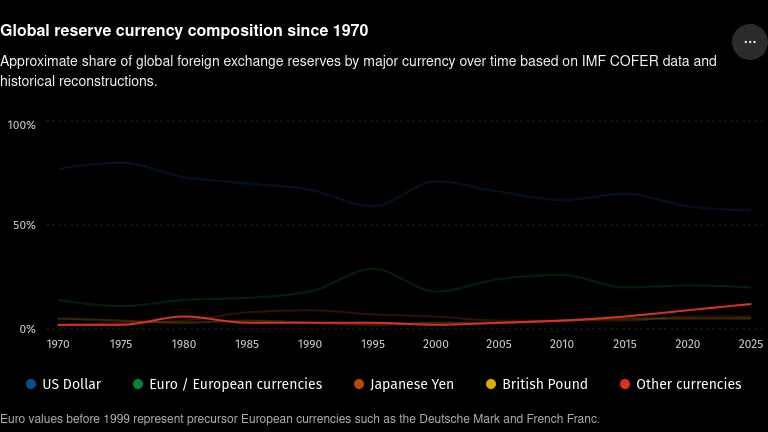
Generated by ChatGPT (Global reserve currency composition since 1970) / Author
A few notable trends:
- The USD peaked above 70% after the collapse of Bretton Woods and again around 2000–2001.
- The euro’s launch in 1999 consolidated several European reserve currencies into one bloc.
- Since the 2008 financial crisis, reserve diversification has increasingly flowed into “nontraditional” currencies rather than just the euro or yen.
- Despite gradual De-dollarization, the dollar still remains by far the dominant reserve currency globally.
The trend is a slow, but continuing decline, not collapse.
Beyond the USD: Trade Invoicing
Oil was historically been invoiced exclusively in dollars (the “petrodollar”). That is changing:
- Russia has moved large parts of its energy trade to ruble/domestic currencies
- China is promoting settlement in renminbi (CNY) for Belt & Road partners
- Regional blocs (e.g., ASEAN, GCC) have discussed local-currency swap arrangements
All of this results in the USD still being dominant, but alternative invoicing is rising in certain corridors.
Central Bank Digital Currencies (CBDCs)
Central Bank Digital Currency (CBDC) is a digital form of a country’s fiat currency issued and backed by its central bank.
Sovereign Digital Currency (SDC) is any digital currency issued or guaranteed by a sovereign government. This may include a CBDC, but the term is broader.
Many countries are exploring or piloting sovereign digital currencies:
- China’s e-CNY (digital yuan) — the most advanced major CBDC
- EU (digital euro research)
- Other major central banks exploring design and interoperability
CBDCs could enable non-USD digital settlements in the future, further diversifying systems.
Trade Agreements & Currency Swap Lines
Some states have established direct currency swap lines that bypass the USD:
- China–Russia
- China–Brazil
- China–South Korea
- Saudi Arabia–China (energy settlement in RMB)
Notice the common thread across all those.
These arrangements reduce dependence on USD clearing. Not sure what clearing means? Learn about payment system mechanics here. Learn about international payment systems here.
Alternative Payment Systems
SWIFT (Society for Worldwide Interbank Financial Telecommunication) is a global messaging network used by banks and financial institutions to securely exchange payment instructions. It’s a whole family of published specs
A key point to keep in mind is that SWIFT does not actually move money. It moves messages about money. A typical SWIFT payment looks like:
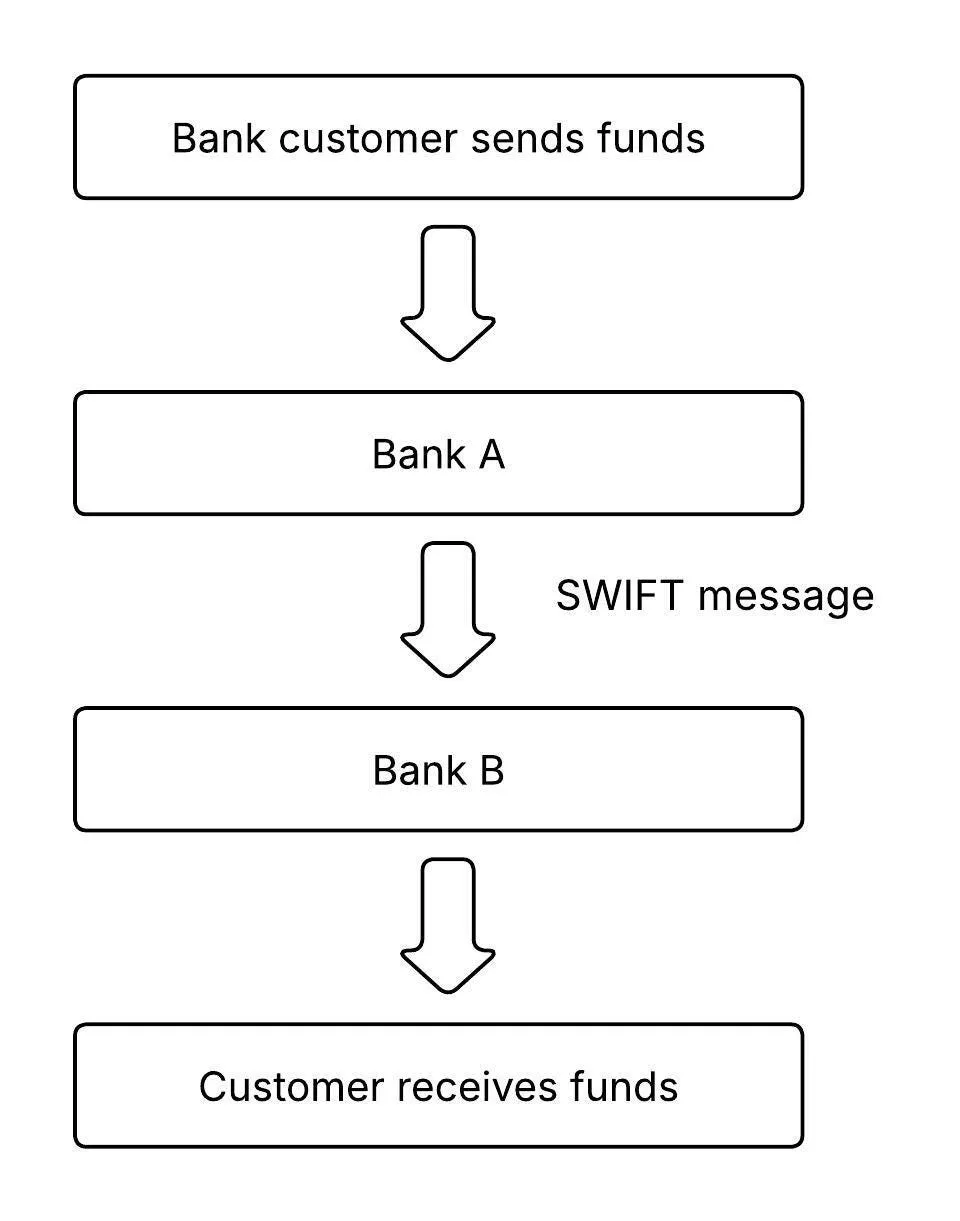
SWIFT Funds Movement
The actual transfer of funds is usually settled through correspondent bank (a bank that provides services on behalf of another bank, usually in a different country) accounts or central bank settlement systems.
SWIFT is important because:
- Connects over 11,000 financial institutions worldwide
- Used in more than 200 countries and territories
- Standardizes international payment messages
- Provides secure and trusted communication between bank
As an example, if someone in the US sends money to a bank account in Germany, the following happens:
- A US Bank customer sends money to someone.
- The US bank sends a SWIFT message.
- Intermediary banks may be involved.
- The German bank receives the instruction and credits the recipient.
SWIFT is the global banking communications network that enables banks to securely send international payment instructions, but it is not itself a payment settlement system.
Countries have expanded non-SWIFT payment messaging systems:
- SPFS (Russia)
- CIPS (China)
These are not replacements for SWIFT yet, but they are invariants (means not changing / varying, it is a constant) in the direction of diversification.
It’s still correspondent bank accounts or central bank settlement systems moving the money around.
USD Structural Advantages
Despite shifts, the USD maintains powerful anchors.
Deep & Liquid Financial Markets
The US Treasury market is the largest safe asset market in the world. This means:
- Network Effects: Banks, derivatives, trade finance, and corporate contracts predominantly quote in USD.
- Legal Certainty: Rule of law, property rights, enforcement mechanisms, and financial architecture reinforce confidence.
- Reserve Currency Inertia: Central banks rarely abandon a dominant reserve currency quickly.
These strengths create stickiness.
Lack of Strong Alternatives
The dollar also benefits from weaknesses in competing currencies:
- The Euro lacks a single unified fiscal authority.
- The Chinese Yuan faces capital controls and convertibility concerns.
- The Japanese Yen economy is much smaller than the US
- Cryptocurrencies remain too volatile and fragmented for large-scale reserve use.
Ability to Run Persistent Deficits
Because the world demands dollars, the US can often finance larger trade and fiscal deficits than most countries.
Economist Robert Triffin described this tension in the famous Triffin Dilemma, The reserve-currency issuer must supply the world with its currency, which often requires running deficits.”
Most countries would face severe pressure doing this; the US enjoys greater flexibility because global demand for dollars remains high.
Military and Geopolitical Influence
The United States has:
- Extensive alliance networks
- Significant military power
- Major influence in global institutions
While military power alone cannot create reserve currency status, it contributes to confidence in the stability of the system backing the dollar.
SWIFT and Banking Infrastructure
Much of the global financial system has historically been built around:
- Dollar clearing
- Correspondent banking
- SWIFT messaging
This makes the dollar deeply embedded in international finance.
Trade Settlement Dominance
A large share of international trade is invoiced and settled in USD, even when neither party is American. Examples of trade where this occurs:
- Oil
- Natural gas
- Commodities
- Shipping
- Aircraft purchases
A company in Brazil buying goods from South Korea may still settle in USD.
This creates a continuous global demand for dollars.
Results In
All of this results in a self-reinforcing system where countries, banks, corporations, and investors use dollars because everyone else uses dollars. That network effect is arguably the dollar’s greatest structural advantage.
Why De-Dollarization Is Happening
Despite the USD structural advantages, ongoing economic and geopolitical forces are contributing to De-dollarization. This includes:
Geopolitical Friction: Sanctions and broader controls motivate countries to reduce exposure to a system where the US can cut them off.
Strategic Autonomy: Countries want greater control over monetary policy and financial sovereignty.
Regional Economic Integration: Regions like BRICS and ASEAN seek intra-regional currency settlement mechanisms for speed and cost advantages.
Currency Strategy: Emerging market central banks prefer diversified reserve portfolios to manage risk.
How Fast Is It Happening?
De-dollarization is real, but slow. We may be decades away from the real effects.
- Reserve share flux: measured in percentage points over years
- Trade invoice changes: gradual, corridor-specific
- Alternative systems: supplementary, not dominant
We are not yet at a point where the dollar’s centrality is rapidly collapsing, but the trend is directionally downward.
Pitfalls and Limits
While those geopolitical forces are pushing the world towards De-dollarization, even if De-dollarization accelerates, there are still practical pitfalls and limits enforced by those anchor points mentioned above, including:
- The dollar is unlikely to lose reserve dominance quickly
- Deep dollar markets are hard to substitute
- Non-USD alternatives lack scale and liquidity
- Network effects strongly favor incumbent currency
However, despite that:
- Diversification can reduce US leverage
- Regional blocs may fragment monetary alignments
- Strategic sectors could shift to alternative systems
Total Number of US Financial Sanctions
There is no single authoritative public dataset for the total number of active US financial sanctions in force by year since 1980. Different organizations measure sanctions differently:
- Number of sanctions programs
- Number of sanctioned entities/persons (SDN listings)
- Number of sanctions designations added annually
- Number of countries under sanctions
The most consistently published quantitative data is annual OFAC/SDN designations. Using publicly available CNAS and OFAC trend data, here’s an approximate visualization of the growth in US financial sanctions activity over time.
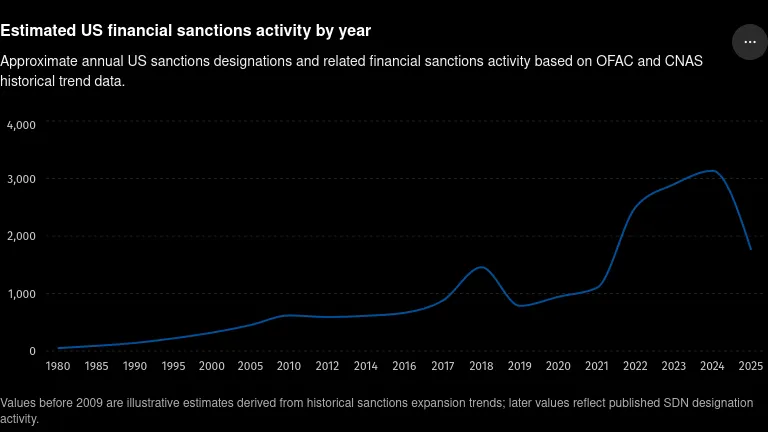
Estimated US financial sanctions activity by year
A few important caveats:
- The sharp rise after 2014 is heavily associated with Russia sanctions, counter-terrorism measures, cyber sanctions, and expanded secondary sanctions authorities.
- The post-2022 spike reflects the response to the Russia-Ukraine war and broader use of financial statecraft.
- “Sanctions activity” here reflects designations/actions, not the count of laws or sanctions programs.
- OFAC sanctions today cover countries, individuals, companies, vessels, crypto wallets, and cyber actors.
- The sharp drop in 2025 reflects the current administration loosening sanctions on Russia and establishing fewer new sanctions in general.
De-Dollarization Leading To Digital Soveriengty For Nations
De-dollarization focuses on money and financial rails.
Digital Sovereignty focuses on data, platforms, networks, and digital systems.
They increasingly overlap because modern finance is now deeply digital.
To achieve Digital Sovereignty, a nation must reduce the dependence on US-Controlled Financial Infrastructure
Reducing Dependence on US-Controlled Financial Infrastructure
The global dollar system is not just “a currency.” It is an ecosystem involving:
- Correspondent banking
- SWIFT messaging
- Dollar clearing banks
- US sanctions enforcement
- US-regulated cloud and financial technology providers
When countries pursue De-dollarization, they often create:
- Domestic payment rails
- Regional settlement systems
- Bilateral currency agreements
- Alternative messaging systems
- Local digital banking infrastructure
That naturally strengthens Digital Sovereignty because critical financial data and transaction control move closer to domestic jurisdiction.
We’ve seen this through:
- China’s CIPS system
- Russia’s SPFS system
- India’s UPI expansion
- BRICS settlement discussions
Achieving this leads a nation to financial sovereignty.
Financial Sovereignty Requires Data Sovereignty
Modern financial systems generate enormous amounts of:
- Identity data
- Transaction metadata
- Commercial intelligence
- Cross-border payment visibility
- Behavioral analytics
If another country controls the infrastructure, they may indirectly gain:
- Economic intelligence
- Enforcement leverage
- Sanctions leverage
- Surveillance capability
So De-dollarization often pushes countries toward:
- Domestic cloud infrastructure
- Local data residency laws
- Sovereign digital identity systems
- Domestic encryption standards
- National payment processors
This is where Digital Sovereignty and financial sovereignty converge.
CBDCs Blur the Line Between Currency and Digital Infrastructure
Central Bank Digital Currencies (CBDCs) are one of the clearest intersections.
A CBDC is simultaneously:
- A monetary instrument
- A payment network
- A digital identity layer
- A programmable software platform
- A national data system
Countries exploring CBDCs often frame them as tools for:
- Reducing dollar dependence
- Improving sanctions resilience
- Increasing domestic control
- Reducing reliance on foreign payment processors
In other words_,_ Sovereign Digital currency requires sovereign digital infrastructure.
Sanctions Accelerate the Push
Many countries became more serious about Digital Sovereignty after seeing:
- Financial sanctions
- Asset freezes
- Payment network restrictions
- Export controls
- Technology bans
This creates the strategic realization that if your economy depends on another nation’s currency and digital infrastructure, your sovereignty can be constrained externally.
As a result, nations increasingly seek:
- Domestic semiconductor capacity
- National AI infrastructure
- Sovereign cloud platforms
- Independent telecom networks
- Non-dollar trade settlement
Digital Sovereignty Expands Beyond Finance
Once countries build sovereign financial systems, the same logic spreads into:
- Social media platforms
- AI models
- Search engines
- Cloud hosting
- App ecosystems
- Data governance
- Cybersecurity
So De-dollarization can become part of a broader national strategy of:
- Technological autonomy
- Economic resilience
- Reduced geopolitical dependency
The Important Caveat
De-dollarization and Digital Sovereignty does not automatically create freedom or privacy for people. In fact, it can do the opposite in the hands of the wrong local government
A sovereign digital system can become:
- More decentralized and privacy-preserving
- Or more centralized and surveilled
Digital Sovereignty can support:
- Individual privacy
- National independence
- State surveillance
- Or all three simultaneously
It depends entirely on governance, legal protections, and technical design.
That’s why debates around:
- CBDCs
- Digital identity
- Encryption
- Data localization
- AI governance
are ultimately debates about who controls the infrastructure of modern society.
Summary
Yes, De-dollarization is real.
Yes, it is accelerating incrementally.
No, it is not yet a crisis for USD dominance.
But, it is very likely a long-term, strategic shift away from the US, especially in geopolitically sensitive regions.
Yes, De-dollarization is a necessary prerequisite to achieving Digital Sovereignty.
No, achieving De-dollarization does not automatically mean a nation will achieve Digital Sovereignty.
A nation, a society, that achieves Digital Sovereignty may or may not improve the Digital Privacy of its citizens, but it would be awesome if that was the outcome.
Notes
- AI / GenAI / ChatGPT / etc were not used to generate the text of this article.
- ChatGPT was used to generate the images.
- I used em dashes in my writing before the current GenAI wave was a thing. Not planning on changing now.
- Names have been changed to protect the guilty.
- None of the hostnames or users used in examples actually exist.
- Feel free to post any comments or suggestions below.
Originally published on Medium.