Post-Quantum Migration Mistakes: How to Accidentally Recreate the Y2K Panic, But With More Math
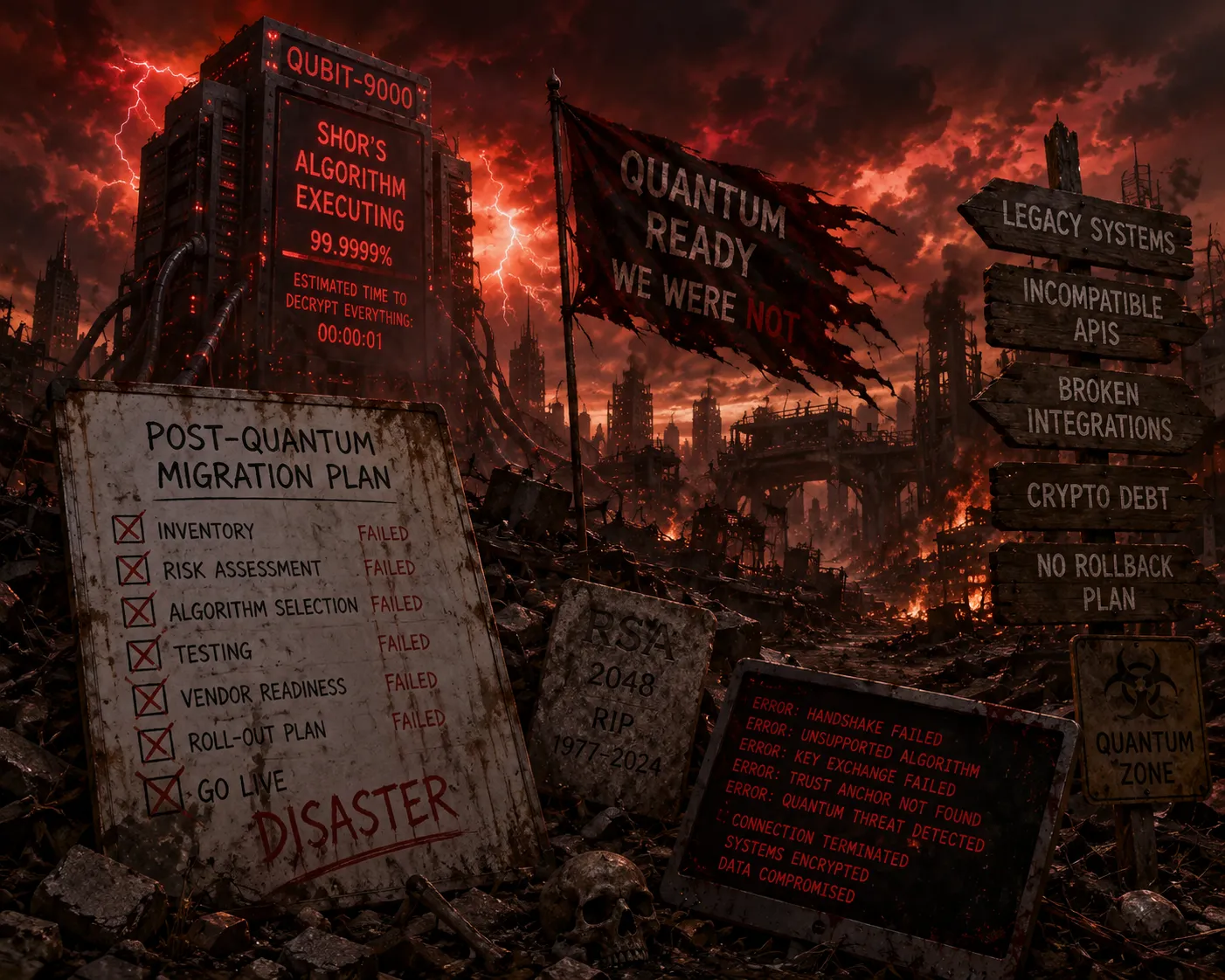
For decades, organizations have enjoyed a comfortable arrangement with modern cryptography.
RSA guarded our secrets. Elliptic curves protected our communications. TLS quietly encrypted our web traffic. Life was good.
Then, quantum computing showed up and began lurking ominously in the corner like a distant storm cloud. Not raining. Not causing immediate problems. Just standing there, silently reminding everyone that one day it might flatten the neighborhood.
The good news is that post-quantum cryptography (PQC) is no longer science fiction. Standards are emerging, implementations are appearing in commercial products, and organizations can begin planning their migrations today.
The bad news is that many organizations are planning these migrations in ways that would make future incident response teams weep openly into their keyboards.
Let’s explore some of the most common mistakes.
Mistake #1: Waiting Until Quantum Computers Exist
A surprisingly popular strategy is that we’ll worry about quantum computers when they become a problem.
This approach has one small flaw.
By the time a cryptographically relevant quantum computer exists, it may already be too late for data that needed protection years earlier.
Attackers don’t necessarily need to decrypt your data today. They can simply collect it and store it.
This strategy is known as “Harvest Now, Decrypt Later.”
Imagine a thief stealing a safe because they believe someone will eventually invent a better lockpick. The safe remains secure today, but the thief is playing the long game.
Organizations should already be evaluating which assets require protection beyond the next decade if they are protecting:
- Intellectual property
- Government data
- Healthcare records
- Financial information
- Long-lived identities and credentials
The migration timeline is measured in years, not weekends.
Mistake #2: It’s Just a Certificate Upgrade
Many executives hear “post-quantum cryptography” and envision something similar to renewing an SSL certificate.
A quick maintenance window.
A few configuration changes.
Maybe a celebratory doughnut afterward.
Unfortunately, a PQC migration resembles replacing the plumbing, electrical wiring, and foundation of a building while people continue living inside it.
Cryptography is everywhere.
It’s embedded in:
- Applications
- APIs
- Mobile device
- Smart cards
- VPNs
- Identity systems
- Hardware security modules
- Embedded devices
- Legacy systems nobody fully understands
If your organization doesn’t have a cryptographic inventory, you probably don’t know how much cryptography you’re using.
And, that’s a problem…
Mistake #3: Not Knowing Where Cryptography Is Used
Ask most organizations_, “Where are all of your cryptographic implementations?” and the response is often similar to asking a homeowner,_ “Can you identify every pipe behind every wall in your house?” Followed by uncomfortable silence.
Many organizations know where their certificates are.
Far fewer know:
- Which applications perform certificate validation
- Which libraries implement RSA
- Which systems use hard-coded keys
- Which vendors ship unsupported cryptographic modules
- Which devices cannot be upgraded
A successful PQC migration begins with cryptographic discovery.
You cannot migrate what you cannot find.
Mistake #4: Vendors Will Handle Everything
Some organizations have adopted the strategy of waiting for vendors to solve the problem.
To be fair, vendors will solve many parts of the problem.
But vendors cannot answer questions such as:
- Which systems are business critical?
- Which applications exchange sensitive data?
- Which integrations can tolerate larger key sizes?
- Which systems have regulatory requirements?
- Which legacy platforms must remain operational?
The vendor may provide the tools.
You still have to build the roadmap.
Mistake #5: Ignoring Performance Impacts
Classical cryptography has benefited from decades of optimization.
Post-quantum algorithms are different.
Some require:
- Larger keys
- Larger certificates
- Larger signatures
- Additional processing
Most environments will handle this just fine.
Some environments will not.
Particularly:
- IoT devices
- Embedded systems
- Constrained networks
- Older hardware
- High-scale authentication systems
The first time you discover performance issues should not be during a production rollout.
That’s what testing environments are for.
It also takes time for implementations of these no algorithms to become optimized. That is a journey. The vendors and opensource communities will take the entire industry on said journey with them.
Mistake #6: Treating the Migration as a Security Project
This is perhaps the most dangerous mistake.
Organizations often assign PQC migration entirely to the security team.
Security teams certainly have a critical role, however, post-quantum migration is also:
- An architecture project
- A networking project
- A platform project
- A procurement project
- A governance project
- A software engineering project
The systems affected may span every department in the organization.
If only the security team is involved, important dependencies will inevitably be missed.
Most InfoSec teams I’ve dealt with are not great at project management — especially at that scale. Accept your strengths and weaknesses and let the corners of your organization that have done large projects help.
Mistake #7: Chasing Every New Industry PQC Announcement
Quantum computing news generates headlines with remarkable efficiency.
Every month seems to bring:
“Quantum Breakthrough Changes Everything!”
Followed by:
“Quantum Revolution Is Imminent!”
And occasionally:
“Quantum Computer Solves Problem Nobody Asked It To Solve!”
As some of the comments have pointed out in earlier posts in my PQC series, yes, I’m helping generate that background noise as well.
Organizations that react to every headline risk constantly changing direction.
Migration planning should be based on:
- Standards
- Risk assessments
- Vendor roadmaps
- Business requirements
Not whichever article generated the most social media engagement this week.
Mistake #8: Forgetting Your Identity Infrastructure
Many organizations focus on TLS certificates and VPNs.
Meanwhile, their identity infrastructure quietly sits in the corner holding the keys to everything.
Identity systems often depend on:
- Certificates
- Token signing
- Federation trust relationships
- Hardware security modules
- Public key infrastructure
A future quantum migration may affect:
- OAuth deployments
- OpenID Connect ecosystems
- SAML federations
- Workforce identity platforms
- Customer identity systems
If identity isn’t part of the migration discussion, the migration discussion isn’t complete.
Mistake #9: There Will Be a Single “Migration Day”
Organizations sometimes imagine a future event resembling a movie montage.
At 2:00 PM:
- RSA is disabled.
- Post-quantum algorithms are enabled.
- Everyone applauds.
- The credits roll.
Reality will be far less dramatic and probably messier.
Most organizations will spend years operating hybrid environments that support both classical and post-quantum algorithms.
Migration will occur gradually.
There will be inventories, assessments, pilots, compatibility testing, phased rollouts, and numerous meetings involving PowerPoint slides.
So many PowerPoint slides.
The Real Goal
The objective is not to become “quantum ready” tomorrow.
The objective is to avoid becoming “quantum surprised” later.
Organizations that succeed will not necessarily be the ones that move fastest.
They will be the ones that:
- Understand where cryptography is used.
- Know which assets require long-term protection.
- Track vendor readiness.
- Test early.
- Build realistic migration plans.
Quantum computers may arrive gradually rather than suddenly. But cryptographic migrations have historically taken far longer than anyone expected.
The organizations preparing today are not predicting the future.
They’re acknowledging a simple truth of technology:
The best time to inventory your cryptography was years ago.
The second-best time is before a quantum computer starts reading your archived data for recreational purposes.
Notes
- AI / GenAI / ChatGPT / etc were not used to generate the text of this article.
- ChatGPT was used to generate the images.
- I used em dashes in my writing before the current GenAI wave was a thing. Not planning on changing now.
- Names have been changed to protect the guilty.
- None of the hostnames or users used in examples actually exist.
- Feel free to post any comments or suggestions below.
Originally published on Medium.