Government Data Collection: The Rise of Over-Collection
Before we start, please note, I’m not taking a stand on any particular issue (social, political, etc). I’m just exploring the potential privacy implications in recent headlines.
Should the state gather information on undocumented immigrants, even if well-intentioned for providing valid driver’s licenses and benefits? The State of New York has been doing this.
Should the state gather data on gender identity to properly fill out a field on a driver’s license? Ask trans people in Kansas.
There are legitimate reasons why this data may be requested / required, but what kind of exposure are you creating for unpopular groups in the long-term? Or, when a different political group comes to power? Or, when all-of-a-sudden one finds themselves in the wrong demographic group?
It may seem like a good idea, but whatever the current political establishment’s intentions, it’s impossible to know who will be in power next week and which group will be targeted.
So, from a privacy standpoint, it may not be in these groups best interest (or anyone’s) that a government is collecting this information in the long-term, despite the short-term gains. Yes, there will always be someone claiming it is a great idea.
I’m not claiming anarchy. I’m all for effective governance. The state must be able to collect taxes, enforce laws, do all that stuff that makes modern civilization run. There is going to be a happy middle ground somewhere, but where is that. Our friends in Europe have probably come closer than anyone else to figuring this out, but have also created a regulatory nightmare.
As I sat here reading over the notes I initially put together for this post, I kept asking myself if I’m wondering into conspiracy theory territory. I think there are some very real events that have happened around the world in the past decade that very much make this a real concern.
In the digital age, data has become one of the most powerful tools any institution can possess. Governments argue that collecting more data about their citizens enables better services, stronger security, and more efficient policy-making.
But there’s a line — often blurry, often shifting — between necessary data collection and excessive surveillance.
When that line is crossed, data stops being a tool for governance and becomes a tool for control.
The Rise of Data Over-Collection
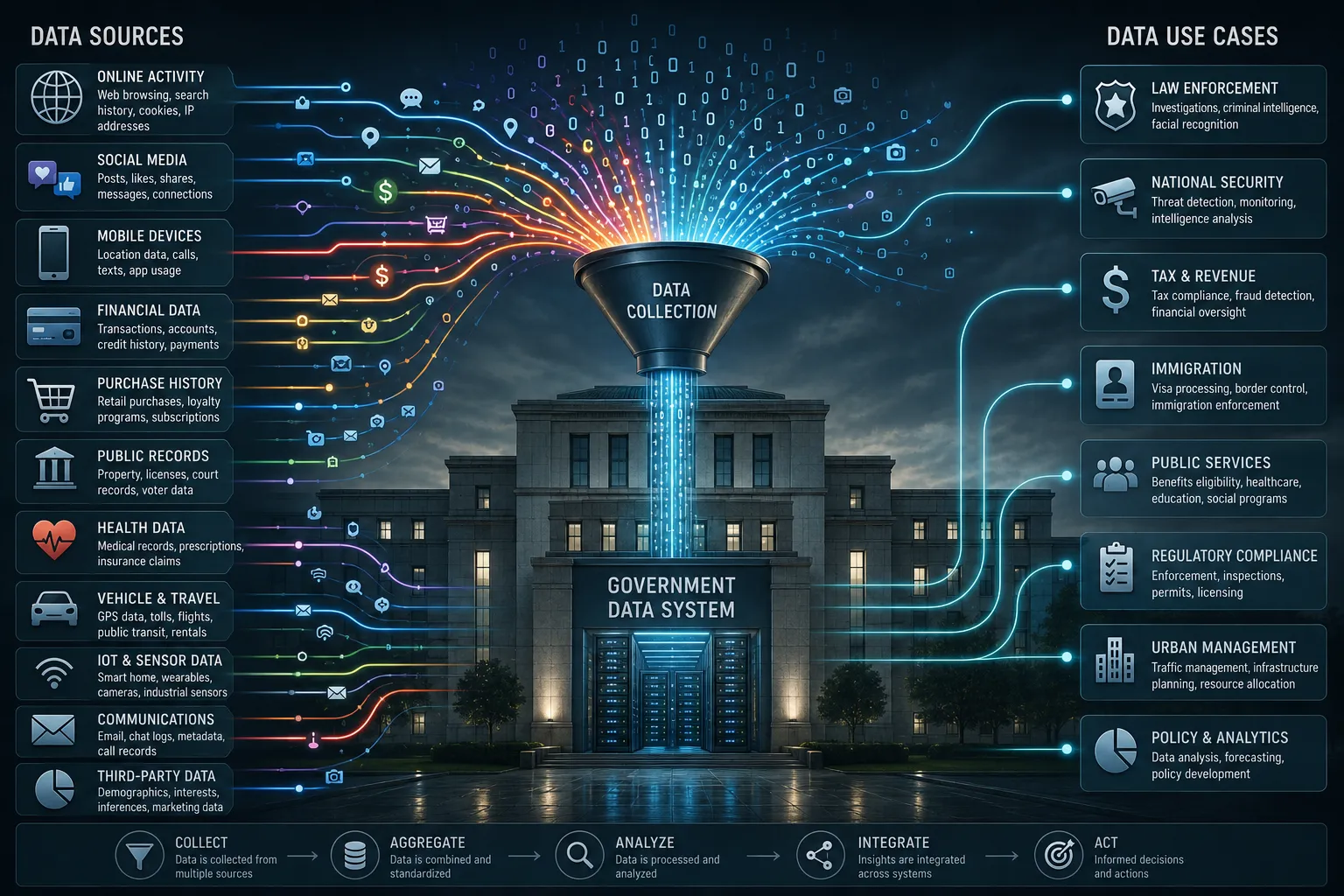
Modern governments collect data at an unprecedented scale, including:
- Financial transactions
- Communication metadata
- Location data
- Biometric identifiers
- Online behavior
Besides what the government directly collects, private industry, has been contributing significant sources of data that bypass traditional government privacy controls. Governments increasingly purchase commercially collected data from private companies because it is often faster, cheaper, and legally easier than obtaining the same information directly through subpoenas, warrants, or intelligence collection. The practice has become controversial because, again, it can bypass traditional privacy protections and oversight mechanisms. This data can include:
- Mobile location data
- Advertising / adtech behavioral data
- Data broker identity profiles
- Financial and transaction data
- Internet and telecom meta data
- Social media and sentiment data
- Biometric and facial recognition data
- Health and wellness data
- Utility / smart infrastructure data
Congratulations to civilization for creating refrigerators capable of participating in surveillance capitalism.
Governments turn to private industry to gather data due to legal simplicity, speed, and scale. The main criticisms of this approach are privacy concerns, Fourth Amendment / civil liberties issues, re-identification risks (in anonymous datasets), and a lack of transparency (how / who / what was obtained).
Individually, each dataset can be justified:
- Combating fraud
- National security
- Public health
- Economic planning
Collectively, they create something far more powerful; a near-complete digital profile of a citizen’s life.
This is justified as efficiency and security. Governments typically frame data collection around three core arguments:
National security
- Detecting terrorism
- Preventing cybercrime
- Monitoring foreign threats
Public service optimization
- Targeting social programs
- Improving healthcare delivery
- Streamlining taxation
Economic oversight
- Reducing tax evasion
- Tracking financial flows
- Supporting monetary policy
These are, generally, legitimate goals. The problem isn’t the intent; it’s the scope and lack of limits — the whole government accountability thing.
Where It Becomes Dangerous
Over-collection becomes abuse when data is used not just to govern, but to shape or suppress political outcomes. This can include:
Political Targeting
Detailed citizen data can be used to:
- Identify political opponents
- Monitor activists and journalists
- Apply pressure selectively
Even without overt repression, the existence of such capability creates a chilling effect.
Behavioral Manipulation
When governments understand:
- What people believe
- What they consume
- How they behave
They can influence:
- Public opinion
- Election outcomes
- Social narratives
This doesn’t require censorship, just precision influence.
Selective Enforcement
With enough data, enforcement can become:
- Uneven
- Politically motivated
- Opaque
Two individuals may commit the same violation, but only one is investigated.
That’s not governance. That’s discretion weaponized.
Permanent Surveillance Infrastructure
Once systems are built, they rarely shrink.
Temporary measures (often introduced during crises) become:
- Permanent
- Expanded
- Normalized
History shows that powers granted to governments are rarely returned voluntarily.
Never let a good crisis go to waste.
The Subtle Shift: From Consent to Assumption
In healthy systems:
- Citizens knowingly provide data
- There are clear boundaries and oversight
In over-collection systems:
- Data is gathered passively
- Consent becomes implicit or irrelevant
- Opting out becomes impractical
At that point, the relationship flips. Citizens are no longer participants — they become subjects of observation
The Role of Digital Systems
Digital transformation accelerates this dynamic:
- Cashless payments → financial traceability
- Digital IDs → unified identity tracking
- Online services → behavioral visibility
- Centralized databases → aggregation of power
Each system improves efficiency. Together, they create: A centralized, highly detailed, and highly accessible record of citizen activity
Why Safeguards Often Fail
Even in democratic systems, safeguards can erode:
- Oversight bodies lack technical expertise
- Legal frameworks lag behind technology
- Emergency powers bypass normal checks
- Data-sharing between agencies expands quietly
And perhaps most importantly:
- Public awareness is low until abuse becomes visible
What Responsible Data Governance Looks Like
Avoiding abuse doesn’t mean abandoning data; it means constraining it.
Key principles include:
Data Minimization: Collect only what is necessary; not what is possible
Purpose Limitation: Data collected for one reason should not be repurposed without oversight
Transparency: Citizens should know:
- What is collected
- How it is used
- Who has access
Accountability: Clear consequences for misuse; not just policies on paper
Decentralization: Avoid single points of control over large datasets
The Tradeoff You’re Actually Making
The real debate isn’t “data vs no data.”
It’s “convenience and control” vs “privacy and autonomy”.
More data enables:
- Better services
- Faster decisions
- Stronger enforcement
But it also enables:
- Surveillance
- Manipulation
- Abuse
Summary
Data is not inherently dangerous, but concentrated, unaccountable data-aggregation power is.
The risk isn’t just what governments do today; it’s what future governments could do with the systems being built now.
Because once the infrastructure for total visibility exists it doesn’t need to be abused often to change behavior — it just needs to be possible.
Government data over-collection becomes dangerous when it shifts from enabling governance to enabling control — especially when combined with weak oversight and political incentives.
Notes
- AI / GenAI / ChatGPT / etc were not used to generate the text of this article.
- ChatGPT was used to generate the images.
- I used em dashes in my writing before the current GenAI wave was a thing. Not planning on changing now.
- Names have been changed to protect the guilty.
- None of the hostnames or users used in examples actually exist.
- Feel free to post any comments or suggestions below.
Originally published on Medium.