API GOVERNANCE: A VITAL BUILDING BLOCK FOR API SECURITY
This post was originally published as “API GOVERNANCE: A VITAL BUILDING BLOCK FOR API SECURITY” on the Ping Identity blog.
Read article: API GOVERNANCE: A VITAL BUILDING BLOCK FOR API SECURITYNotes on application security, API security, identity, and API management from the field. Articles are also published on Medium. Browse the archive by topic instead — 124 subjects.
This post was originally published as “API GOVERNANCE: A VITAL BUILDING BLOCK FOR API SECURITY” on the Ping Identity blog.
Read article: API GOVERNANCE: A VITAL BUILDING BLOCK FOR API SECURITYThis blog post was originally published as “SECURELY USING THE OIDC AUTHORIZATION CODE FLOW AND A PUBLIC CLIENT WITH SINGLE PAGE APPLICATIONS” on the Ping Identity blog.
Read article: SECURELY USING THE OIDC AUTHORIZATION CODE FLOW AND A PUBLIC CLIENT WITH SINGLE PAGE APPLICATIONSEarlier this year, I was working on a project that was using AWS Cognito (as the identity stack) and the AWS API Gateway (as the front-door to all of the API calls). AWS Cognito is a relatively new player in the identity space. It doesn’t support the full OAuth2 or OpenID Connect specs, but, does…
Read article: OpenID Connect Authorization Code Flow with AWS CognitoIn this next post in my Kerberos and Windows Security Series, we are going to look at the use of Kerberos in Microsoft Windows (Microsoft Kerberos). At the end of the day, Kerberos with Windows is more-or-less the same as Kerberos anywhere else; though, there are several proprietary extensions that…
Read article: Kerberos and Windows Security: Kerberos on WindowsI was working with a developer not so long ago and it was explained to me that a caching layer had been added to a services layer (API Provider) to make the authorization (Fine Grained Authorization, FGA) decision more efficient for subsequent API calls. In particular, the cache contains data…
Read article: Authorization Decision Input ParametersWhile researching an upcoming blog post about Kerberos and Mobile, I needed to understand how Identity Providers (like ADFS or Ping Federate) use Kerberos (and possibly Kerberos Delegation) to perform authentication via username and password. This blog post captures what I found for ADFS.
Read article: Active Directory Federation Services (ADFS) and KerberosUpdate (01/31/2021) — Since I originally wrote this article, a proposal has been created that officially describes using JSON Web Tokens (JWTs) as OAuth2 Access Tokens. As of this date, it has not yet been adopted as an official RFC.
Read article: The Benefits of JWTs as OAuth2 Access TokensIt’s 2018. At this point, application developers should not be writing code that directly implements HTTPS calls to OAuth2 or OpenID Connect endpoints, token caching, token refreshes, token validation, or other such activities. An authentication library should be used that implements these…
Read article: OpenID Connect (OIDC) and OAuth2 Authentication LibrariesThis blog post was originally published as “IDENTIVERSE REFLECTIONS: NEWS, TRENDS AND A GLIMPSE INTO THE FUTURE” on the Ping Identity blog.
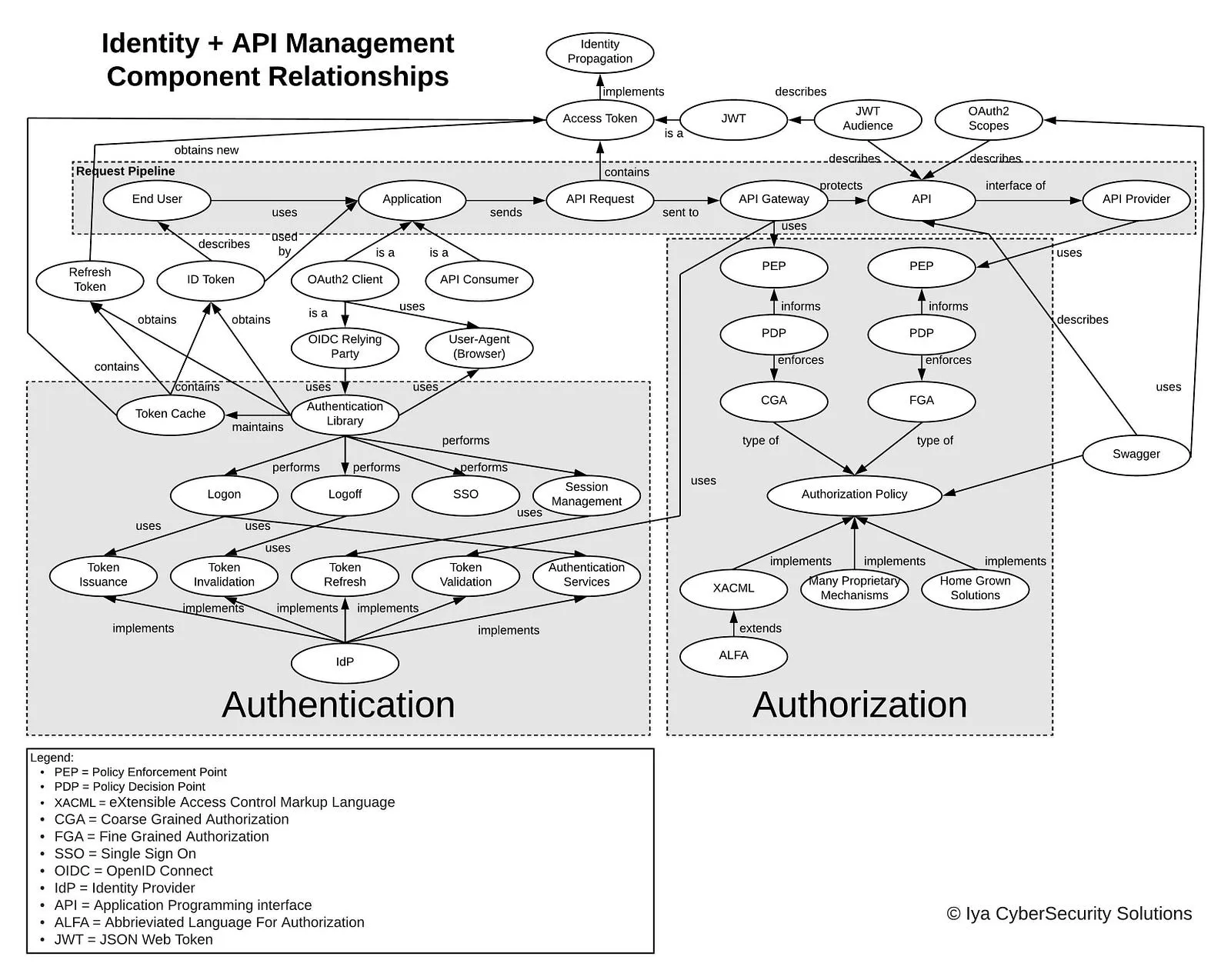
Read article: IDENTIVERSE REFLECTIONS: NEWS, TRENDS AND A GLIMPSE INTO THE FUTUREThis diagram captures the relationships between concepts I’ve been writing about for a couple of years now.
Read article: Identity + API Management Component RelationshipsLooking for something specific? Browse all 124 topics.